
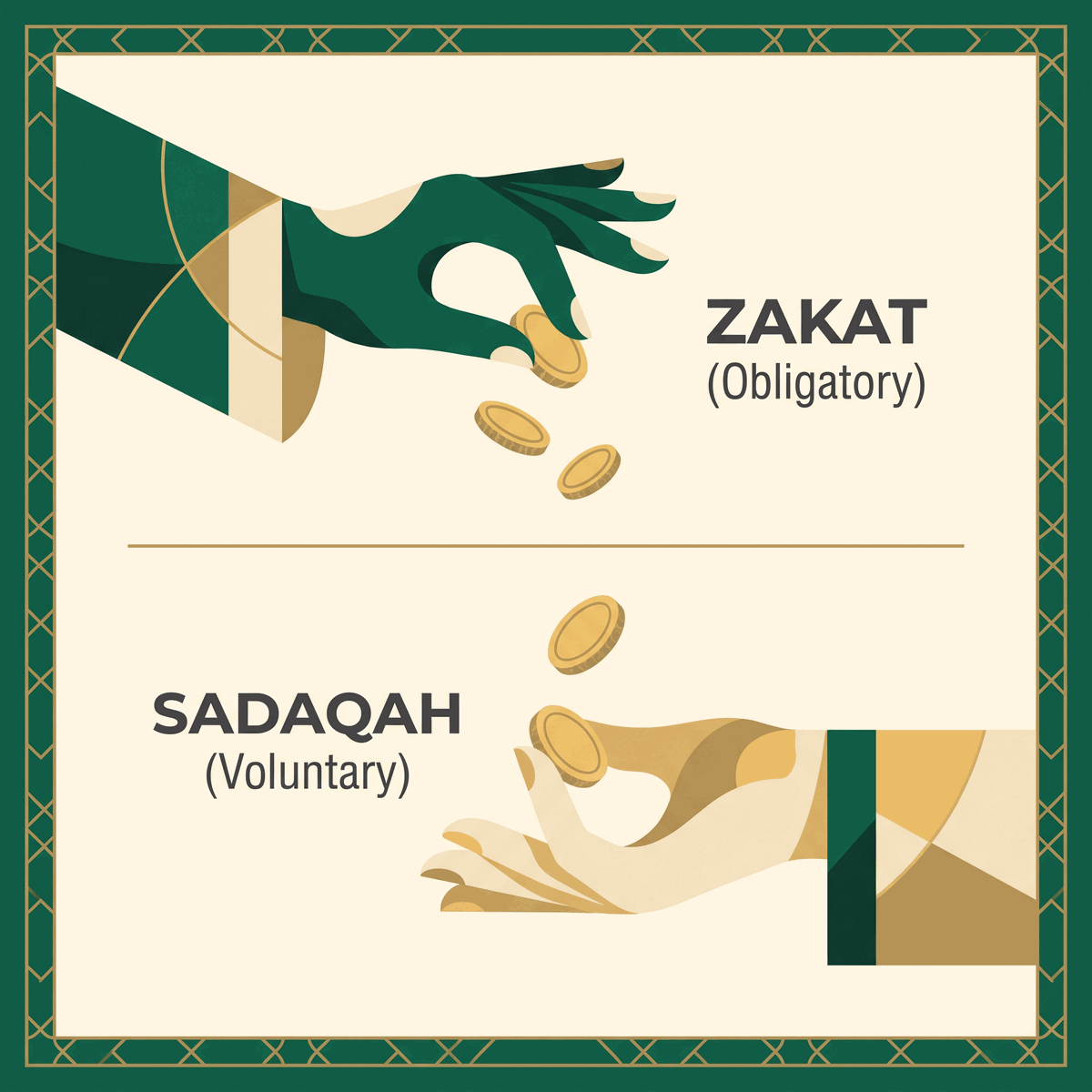
Many Muslims wonder about the exact distinction between Zakat and Sadaqah when reviewing their yearly finances or giving to charitable causes. While both involve giving wealth for the sake of Allah, Islamic jurisprudence draws clear lines between obligatory charity and voluntary giving. Understanding these rules ensures that you fulfill your religious obligations accurately while maximizing the spiritual rewards of voluntary generosity.
The Core Distinction: Obligatory Pillar vs. Voluntary Worship
At its foundation, Zakat is one of the five pillars of Islam, making it a mandatory obligation (fardh) upon every eligible adult Muslim who possesses wealth exceeding a specific threshold known as nisab. Fulfilling Zakat purifies one's wealth and soul, while neglecting it intentionally is a major sin. Allah commands in the Qur'an: "Take, [O Muhammad], from their wealth a charity by which you purify them and cause them increase" (Qur'an, At-Tawbah 9:103).
In contrast, Sadaqah—derived from the Arabic root sidq, meaning truthfulness or sincerity—refers to voluntary acts of charity. Giving Sadaqah demonstrates a believer's sincere devotion to Allah, but there is no sin or penalty for not giving a specific amount at any given time. While Zakat is fixed at a standard rate (usually 2.5%) on qualifying assets held for a full lunar year (hawl), Sadaqah has no minimum or maximum limit, allowing believers to give whatever amount they wish at any moment.
Rules of Distribution: Who Can Receive Zakat vs. Sadaqah?
One of the most crucial distinctions between Zakat and Sadaqah lies in how donated funds can be allocated. Zakat distribution is strictly governed by divine decree, with the Qur'an explicitly defining eight eligible categories of recipients:
"Zakat expenditures are only for the poor and for the needy and for those employed to collect [zakat] and for bringing hearts together [for Islam] and for freeing captives [or slaves] and for those in debt and for the cause of Allah and for the [stranded] traveler - an obligation [imposed] by Allah." (Qur'an, At-Tawbah 9:60).
In the Hanafi school of jurisprudence (fiqh), a fundamental condition for valid Zakat is Tamleek—the transfer of direct personal ownership of wealth to an eligible poor individual. Because of this requirement, Zakat funds cannot be spent directly on public infrastructure, operational overheads, or institutional construction, such as building mosques, digging public wells, or funding school administration. Other Sunni schools of thought share this baseline focus on direct individual entitlement, with minor nuances in specific administrative applications.
Sadaqah, however, carries no such restrictions. Voluntary donations can be given to anyone—rich or poor, Muslim or non-Muslim, relatives or strangers. Furthermore, Sadaqah can be allocated to non-profit infrastructure, mosque renovations, educational programs, and community welfare initiatives.
Calculation, Timing, and Conditions
Calculating Zakat requires evaluating specific financial thresholds and timeframes. To owe Zakat, a Muslim's net wealth must equal or exceed the nisab threshold, which represents the monetary value of 87.48 grams of gold or 612.36 grams of silver. Under standard Hanafi jurisprudence, the silver nisab threshold is commonly applied to maximize benefit for the poor. Once wealth reaches nisab and remains above it for one complete Islamic lunar year (hawl), 2.5% of the qualifying assets (cash, gold, silver, trade stock, and investment growth) becomes due.
Note: Financial calculations and examples provided are for illustrative purposes. Please verify current gold and silver nisab rates or consult a qualified Islamic scholar or financial advisor for your specific situation. You can also use our Zakat calculator tool to estimate your obligatory due.
Sadaqah requires no calculation, waiting period, or qualifying asset threshold. A Muslim can give Sadaqah at any moment—whether donating a small amount after prayer, feeding a neighbor, or supporting emergency relief. Furthermore, while Zakat must be paid in financial or material assets, Sadaqah extends to non-monetary good deeds. The Prophet Muhammad ﷺ said: "Every good deed is charity" (Sahih al-Bukhari, Hadith 6021). Removing an obstacle from the road, sharing a warm smile, or comforting someone in distress are all counted as Sadaqah.
Sadaqah Jariyah: The Perpetual Gift
A unique subcategory of voluntary charity is Sadaqah Jariyah, or ongoing charity. Unlike standard Zakat, which provides immediate relief to individuals in need, Sadaqah Jariyah offers long-term benefits that continue to serve communities over time.
The Prophet Muhammad ﷺ highlighted the enduring benefit of ongoing charity in a famous narration: "When a person dies, his deeds come to an end except for three: Sadaqah Jariyah (ongoing charity), beneficial knowledge, or a righteous child who prays for him" (Sahih Muslim, Hadith 1631).
Examples of Sadaqah Jariyah include digging a water well, planting fruit trees, building a school or clinic, donating copies of the Qur'an, or building a mosque. Long after the donor has passed away, every person who benefits from these projects generates continuous spiritual rewards for the giver.
Balancing Zakat and Sadaqah in Daily Life
Zakat and Sadaqah work together to create a healthy financial and spiritual life. Zakat establishes the mandatory baseline of social welfare, ensuring that wealth circulates fairly and supports the most vulnerable members of society.
Sadaqah lifts a believer beyond basic obligations toward spiritual excellence (ihsan). By building a habit of regular voluntary giving—whether weekly, monthly, or during blessed occasions like Ramadan—Muslims purify their hearts from greed, protect their households, and invite Allah's continuous blessings into their lives.
By understanding the boundaries between obligatory Zakat and voluntary Sadaqah, you can fulfill your duties with precision and practice open-ended generosity with joy.
Frequently Asked Questions
Can I give Zakat to my immediate family members?
No. In Islamic jurisprudence, you cannot give Zakat to family members whom you are already financially obligated to support, such as your parents, grandparents, children, or spouse. However, giving Zakat to needy extended relatives—such as siblings, aunts, uncles, or in-laws—is permissible and encouraged, as it carries a double reward for charity and maintaining family ties. Voluntary Sadaqah can be given to any family member without restriction.
Can Zakat money be used to build a mosque?
In the Hanafi school of thought and the majority opinion among Sunni scholars, Zakat cannot be used directly for mosque construction or upkeep. Zakat requires transferring direct ownership (Tamleek) to an eligible needy individual. Because a mosque is communal property, Zakat paid toward its construction is invalid. Mosque building and maintenance should be funded through voluntary Sadaqah.
Is smiling or helping someone considered Sadaqah?
Yes. Unlike Zakat, which must be paid from qualifying financial assets, Sadaqah encompasses non-material acts of kindness. The Prophet Muhammad ﷺ taught that smiling at your brother, speaking kind words, offering directions to a traveler, or removing harm from a pathway are all recorded as acts of Sadaqah in the sight of Allah.
Sources
- Qur'an 9:60
- Qur'an 9:103
- Sahih al-Bukhari 6021
- Sahih Muslim 1631
- https://seekersguidance.org/answers/hanafi-fiqh/eligible-zakat-recipients-giving-locally-vs-abroad-charity-to-a-mosque-and-proper-handling-of-donations/
- https://www.zakat.org/what-is-the-difference-between-zakat-and-sadaqah