
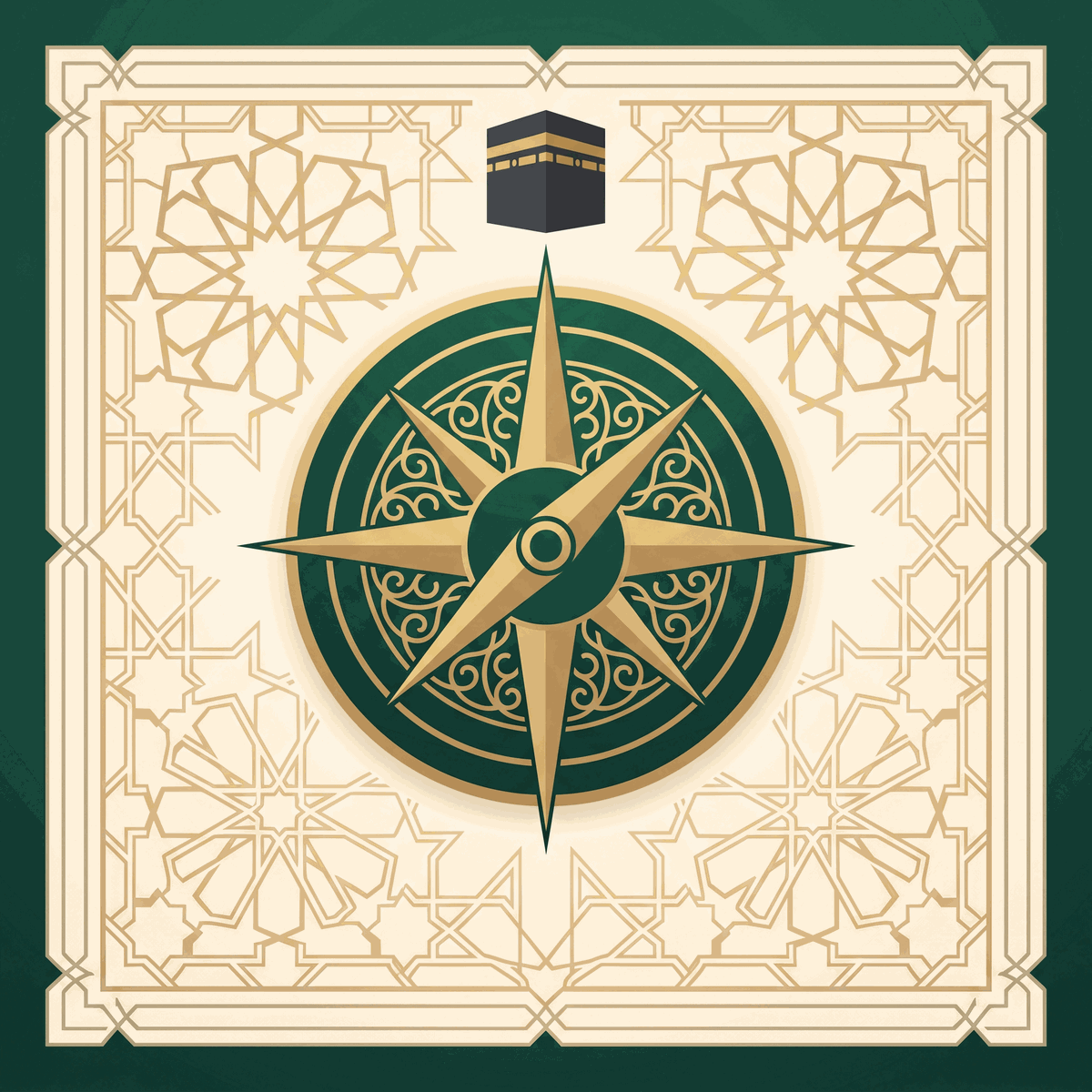
Every day, over one and a half billion Muslims turn toward a single sanctuary in Makkah to perform their daily prayers. Whether you are praying at home in Mauritius, at work in Port Louis, or travelling abroad, knowing the exact direction of the Qibla is an essential prerequisite for valid Salah. This guide explains what the Qibla represents spiritually, how scholars and scientists calculate its precise angle, and how you can easily locate it wherever you are.
What is the Qibla? Spiritual Meaning and Sacred History
The word Qibla (قِبْلَة) in Arabic literally means "direction" or "that which is faced." In Islamic terminology, it refers to the sacred direction that all Muslims face when performing Salah (ritual prayer), making supplications, or carrying out specific acts of worship. Far from being a mere spatial orientation, the Qibla serves as a powerful symbol of spiritual unity, binding believers across every continent to a single central focal point: the Sacred Mosque (Al-Masjid al-Haram) and the Ka'bah in Makkah.
During the early years of Islam in Makkah and for approximately sixteen to seventeen months after the Hijrah (migration) to Madinah, the Prophet Muhammad (peace be upon him) and the early Muslim community prayed facing Jerusalem (Bayt al-Maqdis). However, the Prophet longed to face the Ka'bah—the ancient house of monotheism built by Prophet Ibrahim (Abraham) and his son Isma'il (Ishmael). Allah answered this heart's desire through divine revelation in the Qur'an:
"We have certainly seen the turning of your face, [O Prophet], toward the heaven, and We will surely turn you to a qiblah with which you will be pleased. So turn your face toward al-Masjid al-Haram. And wherever you [believers] are, turn your faces toward it." (Qur'an, Al-Baqarah 2:144)
When this command was revealed, companions who were praying in Madinah turned mid-prayer toward Makkah, an event commemorated at Masjid al-Qiblatain (the Mosque of the Two Qiblas). From that moment on, facing the Ka'bah became a permanent cornerstone of Islamic worship.
Fiqh Rules: Facing the Ka'bah vs. Facing the Direction
In Islamic jurisprudence (fiqh), facing the Qibla (Istiqbal al-Qiblah) is a necessary condition (shart) for the validity of mandatory and voluntary prayers, except under specific circumstances like extreme fear, severe illness, or voluntary prayer while riding on a journey.
Scholars categorize the obligation into two distinct levels based on a person's proximity to Makkah:
- Direct Vision ('Ayn al-Ka'bah): For someone standing inside Al-Masjid al-Haram who can physically see the Ka'bah, exact line-of-sight facing is required.
- General Direction (Jihat al-Ka'bah): For those located far away—such as Muslims in Mauritius, thousands of kilometers from Makkah—facing the general direction of the Ka'bah satisfies the requirement.
Under the Hanafi school of thought, which is followed by the majority of Muslims in Mauritius, facing the general direction (jihat) within an acceptable margin of deviation is fully valid for those distant from Makkah. Other Sunni schools, such as the Shafi'i school, place greater emphasis on trying to align as close to the actual mathematical line as reasonably possible, though all schools recognize that absolute microscopic precision from thousands of miles away is impossible without modern tools.
What if you make a mistake in finding the Qibla?
If you are in an unfamiliar place and have no immediate way to verify the Qibla, you are required to make a sincere effort (ijtihad) using available signs—such as the sun, compasses, or local advice. According to Hanafi fiqh, if you make a genuine effort, pray, and later discover that you were facing the wrong direction, your prayer remains valid and does not need to be repeated. However, if you realize your mistake during the prayer itself, you must immediately turn toward the correct direction without stopping your prayer (Sahih al-Bukhari, Hadith 403).
How the Qibla is Calculated: Astronomy, Geometry, and Sun Shadows
Determining the Qibla over long distances has inspired centuries of breakthroughs in geography, spherical geometry, and astronomy. Because the Earth is a sphere, the shortest distance between any location on Earth and Makkah follows a "great circle route."
In Mauritius, the Qibla direction lies approximately at 336.5° North-Northwest (NNW) relative to True North. To calculate this angle precisely, classical and modern scholars rely on several methods:
1. Great Circle Trigonometry
Using the geographic coordinates (latitude and longitude) of Makkah (21.4225° N, 39.8262° E) and the coordinates of your local city—such as Port Louis (20.1609° S, 57.5012° E)—mathematicians apply spherical trigonometry to calculate the precise bearing.
2. Solar Overhead Alignment (Shadow Observation)
Twice every year, the sun passes directly over the Ka'bah at local solar noon in Makkah. On these days, any object placed vertically on Earth will cast a shadow pointing directly away from or toward Makkah:
- May 27–28 at approximately 13:18 Mauritius Time (09:18 UTC / 12:18 Makkah Time)
- July 15–16 at approximately 13:27 Mauritius Time (09:27 UTC / 12:27 Makkah Time)
By looking at the position of the sun (or the shadow cast by a straight pole) at these exact moments, Muslims around the world can visually verify their Qibla direction with natural accuracy.
3. Historical Mosques and Local Landmarks
For generations in Mauritius, Muslims relied on established historic masjids built by early scholars and community leaders, such as the historic Jummah Mosque in Port Louis. These sacred structures were aligned by knowledgeable pioneers using traditional astronomical compasses and sun observations.
Finding the Qibla in Daily Life and Travelling
Today, determining the Qibla when moving into a new home in towns like Rose Hill, Curepipe, Vacoas, or Quatre Bornes is easier than ever. Modern smartphones equipped with digital magnetometers and GPS make finding the direction instantaneous.
When using a compass or digital tool:
- Ensure you are away from large metallic objects, electrical appliances, or reinforced concrete walls that can distort magnetic sensors.
- Calibrate your phone's compass by moving it in a figure-eight pattern.
- Account for magnetic declination (the difference between Magnetic North and True North).
To make finding the accurate Qibla effortless anywhere in Mauritius or around the globe, you can use our interactive islam.mu Qibla Finder Tool, which uses your device's live location to display the exact direction and compass bearing directly toward the Ka'bah.
Summary: A Facing of the Body and the Heart
While physical orientation toward Makkah fulfills an essential commandment of worship, the ultimate purpose of the Qibla is to orient the believer's heart toward Allah. As the Qur'an reminds us: "And to Allah belongs the east and the west. So wherever you [might] turn, there is the Face of Allah" (Qur'an, Al-Baqarah 2:115). Aligning our physical direction five times a day serves as a constant reminder of our shared faith, brotherhood, and devotion to the One Creator.
Frequently Asked Questions
What should I do if I prayed in the wrong Qibla direction by mistake?
If you exercised reasonable effort (ijtihad) to locate the Qibla before praying, your prayer is valid under the Hanafi school, even if you discover later that your direction was incorrect. If you discover the error while praying, simply turn towards the correct direction immediately and complete your prayer.
On which dates does the sun pass directly above the Ka'bah?
The sun passes directly above the Ka'bah twice a year: on May 27–28 (around 13:18 Mauritius time) and July 15–16 (around 13:27 Mauritius time). Looking toward the sun (or facing directly opposite its shadow) at these exact moments gives you the direct Qibla line.
Do I need exact millimeter precision when finding the Qibla from Mauritius?
No. For believers living thousands of kilometers away from Makkah, facing the general direction (jihat al-ka'bah)—which for Mauritius is North-Northwest (around 336°)—is fully sufficient for the validity of Salah according to mainstream Sunni jurisprudence.
Sources
- Qur'an, Al-Baqarah 2:144
- Sahih al-Bukhari, Hadith 403
- https://quran.com/al-baqarah/144
- https://timesprayer.com/en/direction-qibla-port-louis.html