
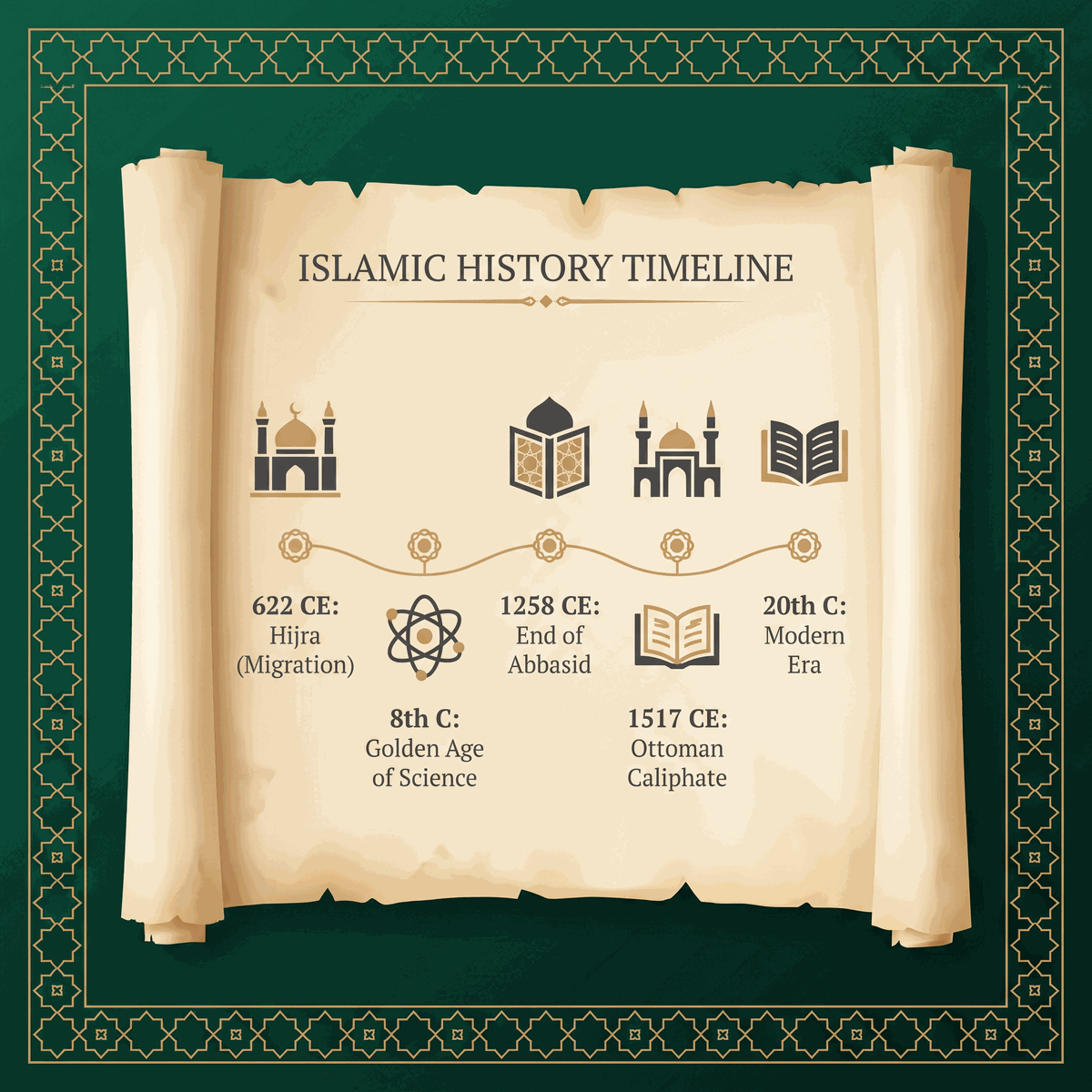
How can we understand fourteen centuries of Islamic civilization without getting lost in vast dates and names? Looking at history through primary Islamic sources—such as classical chronicles, Qur'anic commentaries, and verified Hadith collections—provides an authentic timeline of how the Muslim ummah grew from a small community in Makkah into a global faith. Here is a high-level overview of the major epochs in Islamic history spanning from the 7th century to the 20th century.
The Dawn of Revelation and the Rightly Guided Caliphs (610–661 CE)
Islamic history begins in 610 CE in the cave of Hira near Makkah, where the Prophet Muhammad (peace be upon him) received the first revelation of the Qur'an through the Angel Jibril: "Read in the name of your Lord who created" (Qur'an, Al-Alaq 96:1). For thirteen years, the Prophet preached pure monotheism (tawhid) under intense persecution from the Quraysh. In 622 CE, divine permission was granted to migrate to Madinah, an event known as the Hijrah, which marks Year 1 of the Islamic Hijri calendar.
As recorded in early biographical works such as Sirat Rasul Allah by Ibn Ishaq (edited by Ibn Hisham) and authentic narrations in Sahih al-Bukhari, the Madinan state established religious freedom, social welfare, and brotherhood. Following the bloodless Conquest of Makkah in 630 CE (8 AH) and the passing of the Prophet (peace be upon him) in 632 CE (11 AH), leadership passed to the Rightly Guided Caliphs (Al-Khulafa' ar-Rashidun): Abu Bakr, Umar, Uthman, and Ali (may Allah be pleased with them all).
Classical historian Imam al-Tabari details in his primary historical work Tarikh al-Rusul wa al-Muluk (History of the Prophets and Kings) how Caliph Abu Bakr commissioned the compilation of the Qur'an into a single bound volume (mushaf). During the caliphates of Umar and Uthman, Islam expanded rapidly across the Levant, Egypt, and Persia, while Caliph Uthman standardized the official Qur'anic manuscripts sent to major provinces. The period ended with the martyrdom of Caliph Ali in 661 CE, concluding thirty years of righteous prophetic caliphate.
The Umayyad and Abbasid Eras: Expansion and the Golden Age (661–1258 CE)
In 661 CE, Mu'awiyah ibn Abi Sufyan established the Umayyad Caliphate, shifting the political capital from Madinah to Damascus. Historian Al-Baladhuri records in Futuh al-Buldan (Conquests of the Lands) how the Umayyads expanded the borders of the Islamic world west across North Africa into Al-Andalus (Spain) and east to the Indus Valley in South Asia. Despite political shifts, Arabic became the universal language of administration and scholarship across three continents.
The Abbasid Revolution in 750 CE moved the imperial capital to Baghdad, marking the beginning of the Islamic Golden Age. Under Abbasid patronage, scholars in Baghdad founded the Grand Library and translation institute known as Bayt al-Hikmah (House of Wisdom). Scholars translated and expanded upon Greek, Persian, and Indian scientific texts, pioneering breakthroughs in algebra, astronomy, optics, and medicine.
Simultaneously, classical Islamic scholarship reached its zenith. As documented by scholar Ibn Kathir in Al-Bidayah wa al-Nihayah (The Beginning and the End), this era witnessed the codification of Islamic jurisprudence (fiqh) by the founders of the four Sunni madhhabs—Imam Abu Hanifa, Imam Malik, Imam al-Shafi'i, and Imam Ahmad ibn Hanbal—as well as the compilation of the six canonical Hadith collections (Al-Kutub al-Sittah). Though the political power of Baghdad fragmented over time, the spiritual and intellectual unity of the ummah remained firm until the catastrophic Mongol destruction of Baghdad in 1258 CE.
The Three Regional Empires and Ocean Trade Networks (1258–1798 CE)
Following the Mongol invasions, Muslim political power regrouped and culminated in three dominant regional empires during the early modern period: the Ottoman Empire in Anatolia and the Middle East, the Safavid Empire in Persia, and the Mughal Empire in South Asia. Historian Ibn al-Athir's chronicle Al-Kamil fi al-Tarikh (The Complete History) captures the resilience of Muslim societies during these transitional periods.
In 1453 CE, Ottoman Sultan Mehmed II conquered Constantinople, transforming the Ottoman state into a dominant transcontinental power spanning Southeastern Europe, Western Asia, and North Africa. Meanwhile, in South Asia, the Mughal Dynasty established rich artistic, architectural, and legal traditions recorded in primary administrative texts like the Baburnama and Akbarnama.
Beyond land empires, maritime trade networks flourished across the Indian Ocean. Arab, Persian, and Indian Muslim merchants carried Islamic culture, Sufi spiritual guidance, and ethical commerce to East Africa, South Asia, and Southeast Asia. These trade routes connected the Indian Ocean rim, establishing peaceful Muslim settlements along coastal ports—a maritime legacy that eventually brought Islam to the Mascarene islands.
Colonial Encroachment, Reform, and the Modern Era (1798–20th Century)
The late 18th century marked the beginning of intensive Western colonial pressure on the Muslim world, signaled by Napoleon Bonaparte's military invasion of Egypt in 1798 CE. The Egyptian scholar Abd al-Rahman al-Jabarti provided an indispensable primary account of this period in his chronicle Aja'ib al-Athar, recording the cultural and political shockwaves felt throughout the region.
Throughout the 19th and early 20th centuries, large parts of the Muslim world came under European colonial rule. In response, Muslim scholars (ulema) focused on educational preservation, legal reform, and spiritual renewal to safeguard Islamic identity. The formal dissolution of the Ottoman Caliphate in 1924 CE officially ended the traditional institution that had represented symbolic political continuity for centuries.
In Mauritius, the 19th century saw the arrival of Muslim indentured workers and merchants from South Asia. These pioneers established foundational religious institutions, including the historic Jummah Mosque in Port Louis in the 1850s, ensuring that Sunni Islamic practice took firm root on the island. Across the 20th century, former colonies gained independence, giving rise to modern nation-states alongside a renewed global interest in authentic Islamic scholarship and community building.
By examining Islamic history through primary classical sources, believers gain a grounded perspective on the resilience, intellectual depth, and divine protection that have sustained the ummah across fourteen centuries.
What are primary sources in Islamic history?
Primary sources are first-hand documents, eyewitness accounts, and early historical texts written by classical scholars who lived during or near the events described. Key examples include the Qur'an, verified Hadith compilations, early biographies (Sirah), and classical multi-volume chronicles like Tarikh al-Tabari by Imam al-Tabari and Al-Bidayah wa al-Nihayah by Ibn Kathir.
Why is the Hijrah used as the starting point of the Islamic calendar?
The Hijrah—the migration of Prophet Muhammad (peace be upon him) from Makkah to Madinah in 622 CE—was designated as the starting point of the Islamic calendar during the caliphate of Umar ibn al-Khattab (may Allah be pleased with him). The Hijrah represented the creation of a sovereign, just Muslim community based on faith, brotherhood, and moral law rather than tribal lineage.
How did Islam spread across the Indian Ocean to Mauritius?
Islam spread throughout the Indian Ocean region through maritime trade routes, migrating scholars, and labor movements. In Mauritius, Muslim immigrants arriving from South Asia during the 19th century brought their Hanafi and Sunni traditions, building mosques, madrasahs, and charitable organizations that continue to nourish the local Muslim community today.
Sources
- Al-Tabari, Tarikh al-Rusul wa al-Muluk
- Ibn Kathir, Al-Bidayah wa al-Nihayah
- Ibn Hisham, Sirat Rasul Allah
- Al-Baladhuri, Futuh al-Buldan
- https://www.britannica.com/topic/Islamic-world