
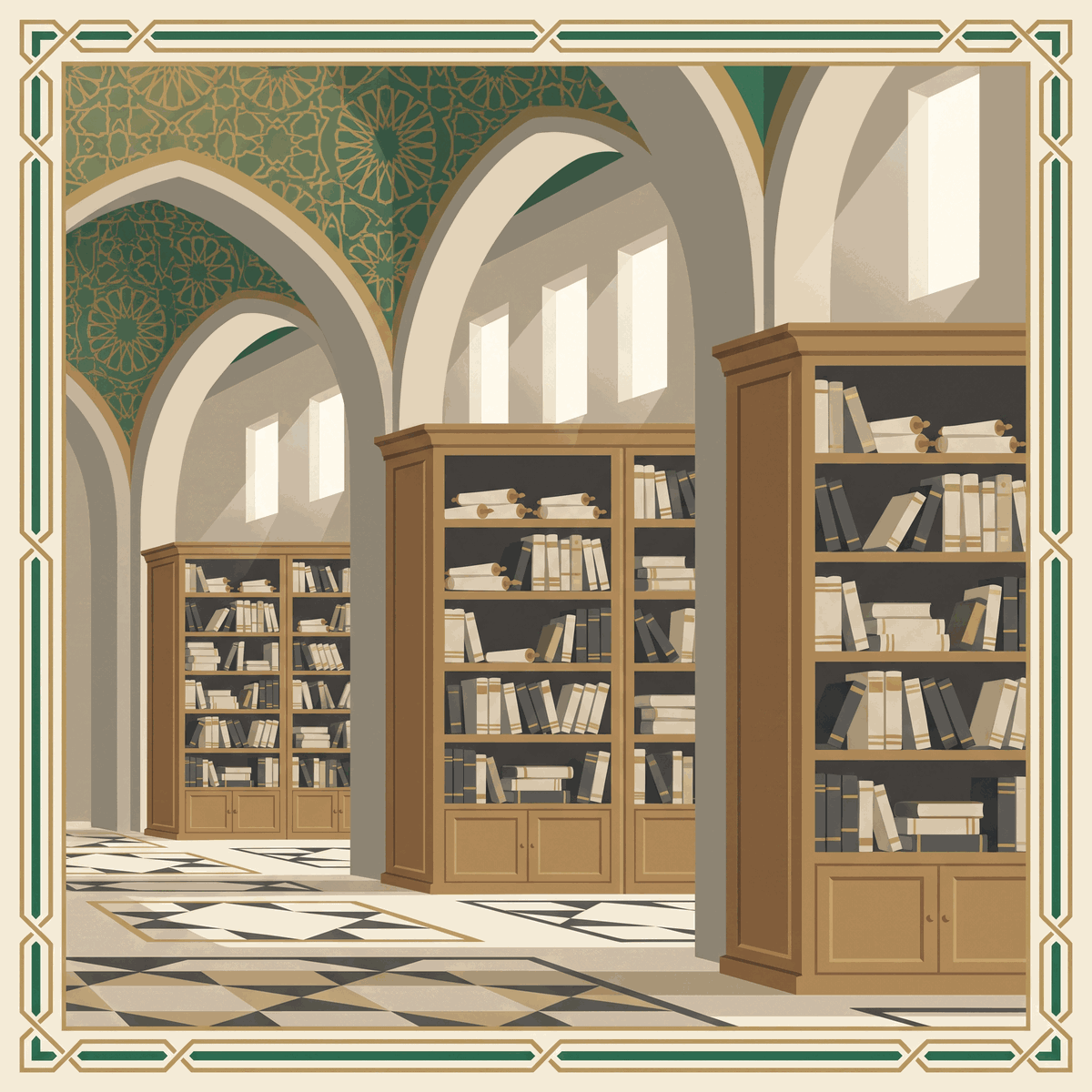
Many Muslims today wonder how early Islamic civilization became the undisputed global leader in science, mathematics, and philosophy. The answer lies largely in ninth-century Abbasid Baghdad at Bayt al-Hikmah—the House of Wisdom. Here, faith, scholarly curiosity, and royal patronage converged to create one of the most remarkable intellectual revivals in human history.
The Origins of Bayt al-Hikmah: From Royal Library to Global Hub
In the late eighth century, the Abbasid Caliph Harun al-Rashid (reigned 786–809 CE) established a private royal archive in Baghdad known as Khizanat al-Hikmah (the Treasury of Wisdom). Baghdad itself was a newly built, thriving metropolis situated at the crossroads of major trade routes. The city quickly became a magnet for merchants, artisans, and scholars from across Asia, Africa, and the Mediterranean.
Under Harun al-Rashid's son, Caliph Al-Ma'mun (reigned 813–833 CE), this modest palace collection expanded into a public academy, astronomical observatory, translation bureau, and sprawling library. Al-Ma'mun personally invited scholars regardless of their religious or ethnic backgrounds, funding their research generously from the state treasury.
A major catalyst for this intellectual explosion was the introduction of paper-making technology, acquired from East Asia in the eighth century. Paper mills established in Baghdad made books far cheaper and more durable than parchment or papyrus. As a result, manuscripts could be copied, distributed, and preserved on an unprecedented scale, transforming Baghdad into the intellectual capital of the world.
The Great Translation Movement: Uniting World Knowledge
At the heart of the House of Wisdom was the Translation Movement—a massive, state-sponsored effort to translate the world's scientific and philosophical heritage into Arabic. Scholars collected manuscripts from Greece, Persia, India, Syria, and China. Works by Aristotle, Plato, Euclid, Archimedes, Hippocrates, and Galen were brought to Baghdad and systematically translated.
One of the most famous directors of translation was Hunayn ibn Ishaq (808–873 CE), a Nestorian Christian physician who mastered Arabic, Syriac, Greek, and Persian. His precise, elegant translations of Greek medical and scientific texts set the standard for academic rigor across the Islamic empire. The caliphs were so appreciative of his work that legend says Al-Ma'mun paid Hunayn the weight of translated books in pure gold.
Far from being passive translators, these scholars critically annotated, corrected, and expanded upon ancient texts. This open pursuit of truth reflected the deep Islamic imperative to seek knowledge wherever it could be found. The Qur'an frequently urges believers to reflect upon the universe and value scholarship:
"Say, 'Are those who know equal to those who do not know?' Only they will remember who are people of understanding." (Qur'an, Az-Zumar 39:9)
By converting ancient knowledge into Arabic, scholars created a shared scientific language that allowed thinkers from Spain to Central Asia to collaborate seamlessly.
Masterminds of the House of Wisdom: Pioneers Who Changed History
The environment inside the House of Wisdom nurtured brilliant polymaths whose discoveries laid the foundations of modern science and mathematics:
- Muhammad ibn Musa al-Khwarizmi (c. 780–850 CE): Working as a senior mathematician at the House of Wisdom, Al-Khwarizmi authored Al-Kitab al-mukhtasar fi hisab al-jabr wa'l-muqabala ("The Compendious Book on Calculation by Completion and Balancing"). This revolutionary work established algebra as an independent mathematical discipline. His name gave rise to the word algorithm, and his adaptation of the Indian numeral system introduced the decimal number system and the concept of zero to the West.
- Abu Yusuf Ya'qub ibn Ishaq al-Kindi (c. 801–873 CE): Known as the "Philosopher of the Arabs," Al-Kindi synthesized Greek philosophy with Islamic theology, argued for the harmony between faith and reason, and made groundbreaking contributions to cryptography, medicine, and music theory.
- The Banu Musa Brothers (9th century): Three gifted brothers—Muhammad, Ahmad, and Hasan—were educated at the House of Wisdom. They authored the Book of Ingenious Devices, describing over one hundred automated mechanical inventions, fountains, and programmable instruments, anticipating modern control systems and engineering.
These scholars fulfilled the Prophet's guidance regarding the paramount value of seeking wisdom: "Seeking knowledge is an obligation upon every Muslim." (Sunan Ibn Majah, Hadith 224; graded sahih).
Faith and Reason in Harmony: The Islamic Ethos of Inquiry
A common misconception today is that scientific exploration and religious devotion exist in conflict. The Golden Age of Baghdad demonstrates the exact opposite: deep Islamic faith was the very engine that drove scientific research.
In the Islamic worldview, the physical universe is a collection of signs (ayat) created by Allah for human beings to observe, ponder, and understand. Calculating prayer times, determining the direction of the Qibla, predicting lunar phases for the Islamic calendar, and developing life-saving medicines were all seen as direct acts of worship (ibadah).
The Qur'an encourages this empirical observation: "And He has subjected to you whatever is in the heavens and whatever is on the earth—all from Him. Indeed in that are signs for a people who give thought." (Qur'an, Al-Jathiyah 45:13). The scholars of the House of Wisdom saw no boundary between studying scripture and studying nature; both were paths toward knowing the Creator.
The End of an Era and its Enduring Legacy
The physical House of Wisdom met a tragic end in 1258 CE when the Mongol army commanded by Hulagu Khan besieged and sacked Baghdad. Historical accounts record that millions of books were thrown into the Tigris River, turning its waters black with ink and red with the blood of scholars.
However, the ideas cultivated within the House of Wisdom could not be destroyed. Centuries before the siege, texts translated and produced in Baghdad had already traveled across North Africa into Islamic Spain (Al-Andalus) and Sicily. European scholars translated these Arabic treatises into Latin, sparking the European Renaissance and the birth of modern science.
For modern Muslim communities—including families and students here in Mauritius—the legacy of the House of Wisdom offers an inspiring roadmap. It reminds us that our faith calls us to lead in education, embrace intellectual curiosity, build bridges across cultures, and contribute meaningfully to human progress.
Frequently Asked Questions
What was the House of Wisdom and where was it located?
The House of Wisdom (Bayt al-Hikmah) was a world-famous academy, library, and translation center located in Baghdad, Iraq. It served as the intellectual hub of the Islamic Golden Age from the late 8th century until the Mongol sack of Baghdad in 1258 CE.
Who founded the House of Wisdom in Baghdad?
It was initially established as a palace archive by the Abbasid Caliph Harun al-Rashid (reigned 786–809 CE) and was formally expanded into a major public academy and research institution by his son, Caliph Al-Ma'mun (reigned 813–833 CE).
How did the House of Wisdom influence modern science?
Scholars at the House of Wisdom invented algebra, introduced Hindu-Arabic numerals (including zero) to the wider world, advanced optics, medicine, and astronomy, and preserved ancient Greek and Persian texts that later fueled the European Renaissance.
The House of Wisdom stands as a timeless testament to what is possible when faith, reason, and open-minded inquiry unite. By rekindling this reverence for learning in our homes and schools today, we honor an Islamic heritage that once illuminated the world.
Sources
- Encyclopaedia Britannica: House of Wisdom
- 1001 Inventions: The House of Wisdom
- Stanford Encyclopedia of Philosophy: Al-Kindi
- https://en.wikipedia.org/wiki/House_of_Wisdom