
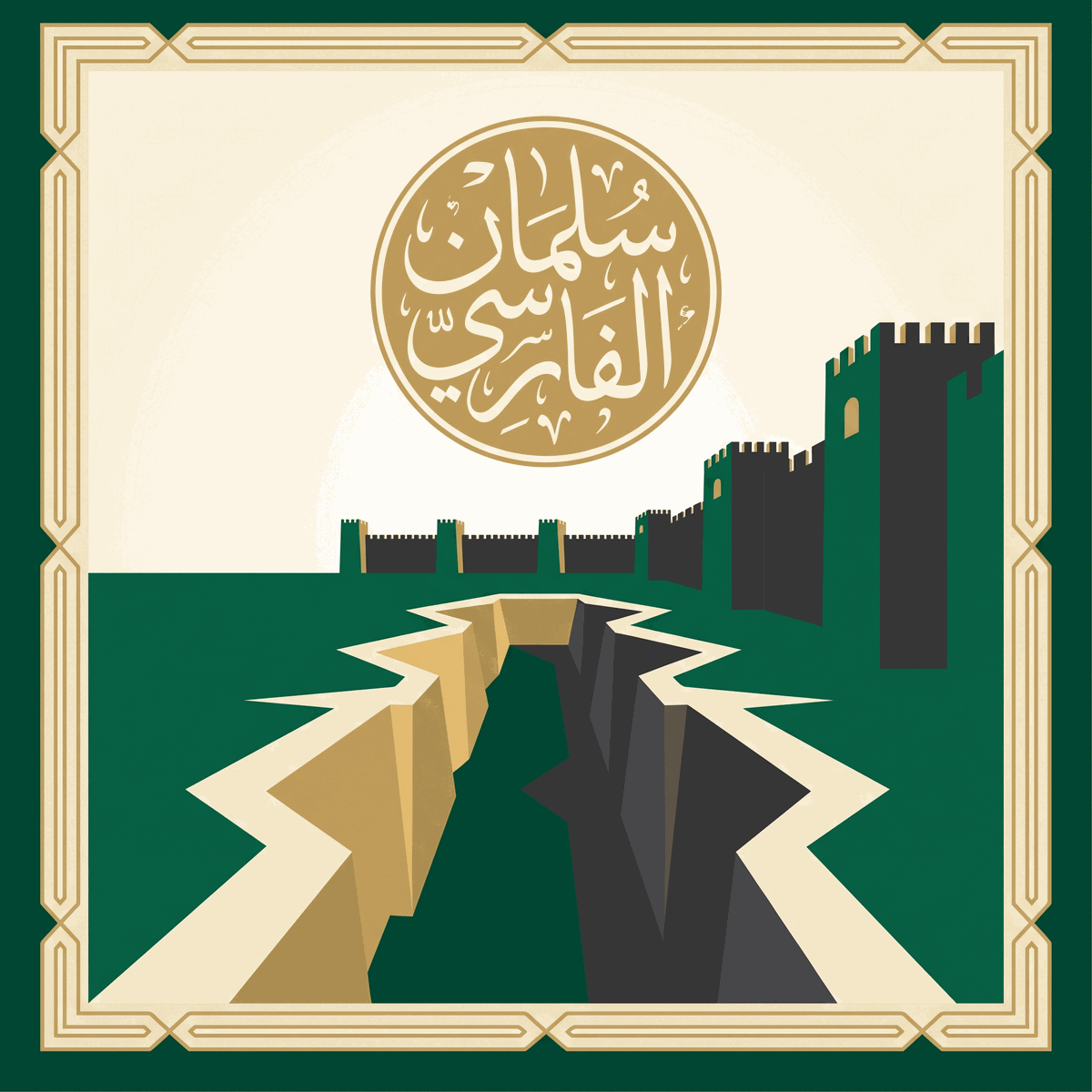
How does a young man from a wealthy Persian family in Isfahan journey across continents, endure years of hardship and slavery, and ultimately become one of the most revered companions of Prophet Muhammad ﷺ? The story of Salman al-Farisi (RA) is a breathtaking epic of truth-seeking, humility, and strategic wisdom that reshaped early Islamic history. For Muslims today seeking inspiration in navigating diverse cultures and standing firm in faith, his journey offers profound lessons.
Early Life and the Epic Search for Truth
Born as Rouzbeh in the village of Jayy near Isfahan, Persia, Salman al-Farisi (RA) grew up in an influential family. His father was a prominent leader and a devout Zoroastrian priest who guarded the temple fire. Raised in comfort, young Salman was assigned the prestigious duty of keeping the sacred fire burning. Yet despite his privileged life, his heart yearned for authentic spiritual truth.
One day, while visiting his father's estate, Salman passed by a Christian church and heard the congregation in prayer. Drawn by their devotion, he entered to observe them. Realizing that this monotheistic faith resonated more deeply with his soul than Zoroastrianism, he inquired where Christianity originated. Upon learning it stemmed from Syria, he left his wealth behind and set out on a perilous journey across the Middle East.
For years, Salman moved from one righteous scholar to another across Syria, Al-Mawsil (Mosul), Nisibis, and Ammuria. As his final teacher lay on his deathbed in Ammuria, Salman asked where he should turn next. The scholar replied that no true teachers of their lineage remained, but foretold the imminent arrival of the final Prophet in Arabia, a land rich with date palms between two volcanic tracts.
The scholar gave Salman three precise signs to identify this long-awaited Prophet:
- He accepts gifts (hadiyah) and eats from them.
- He does not eat from charity (sadaqah).
- He carries the Seal of Prophethood (Khatam an-Nubuwwah) between his shoulder blades.
Driven by a search for truth, Salman hired Arab merchants to guide him to Arabia. However, near Wadi al-Qura, the merchants betrayed him, selling him into slavery to a Jewish master. He was later sold to another master from the Banu Quraydhah tribe and taken to Yathrib (Madinah). Though trapped in servitude, Salman rejoiced when he saw Yathrib's date palms, recognizing the location described by his teacher.
Freedom and Embracing Islam in Madinah
While working in his master's date palm orchard, news reached Salman that a prophet had arrived in Quba, outside Madinah. Overjoyed, Salman gathered food and set out to test the three signs passed down by his teacher.
Upon meeting Prophet Muhammad ﷺ in Quba, Salman presented food, stating it was charity for the needy. The Prophet ﷺ instructed his companions to eat but refrained from eating any himself. A few days later in Madinah, Salman returned with more food, presenting it as a gift. The Prophet ﷺ ate from it and shared it with his companions.
Finally, Salman accompanied the Prophet ﷺ to a funeral in Baqi al-Gharqad. As the Prophet ﷺ walked, Salman tried to look behind his back. Discerning his intention, the Prophet ﷺ adjusted his garment, revealing the Seal of Prophethood between his shoulders. Salman wept, embraced the Prophet ﷺ, and recited the declaration of faith.
Though now a Muslim, Salman remained enslaved and was unable to participate in the Battle of Badr or Uhud. The Prophet ﷺ advised him to write a contract of emancipation (mukataba). His master demanded 300 date palm trees and forty ounces of gold. The Prophet ﷺ called upon the companions to help, and the Prophet ﷺ himself planted the saplings with his blessed hands. Every single tree flourished, and with gold provided from the public treasury, Salman gained his freedom.
The Battle of the Trench and Strategic Wisdom
Salman al-Farisi (RA) made his battlefield contribution during the Battle of the Trench (Ghazwat al-Khandaq) in 5 AH (627 CE). A coalition (Ahzab) of 10,000 enemy soldiers marched toward Madinah to destroy the Muslim community. Facing an overwhelming force, the Muslims held a council of war.
Salman (RA) proposed a revolutionary strategy drawn from his Persian heritage: digging a wide, deep trench (khandaq) along the open northern perimeter of Madinah—the only side exposed to cavalry attacks. Digging a trench was a tactic unheard of in traditional Arabian warfare.
The Prophet ﷺ accepted his advice and joined the companions in digging the trench through rock and soil. When the coalition armies arrived, the impassable ditch halted their advance. The resulting siege dragged on until harsh weather broke the enemy alliance, saving Madinah from destruction.
During the digging, a friendly dispute arose between the Emigrants (Muhajirun) and the Helpers (Ansar), each claiming Salman as one of their own. Hearing this, Prophet Muhammad ﷺ honored him, saying: "Salman is from us, the Ahl al-Bayt" (Al-Hakim, al-Mustadrak). Furthermore, Abu Hurairah (RA) reported that when Surah al-Jumu'ah was revealed, the Prophet ﷺ placed his hand on Salman and said: "If faith were at the Pleiades, a man from these people [the Persians] would surely attain it" (Sahih al-Bukhari, Hadith 4897; Sahih Muslim, Hadith 2546).
Asceticism, Balance, and Governance in Al-Mada'in
Following the passing of Prophet Muhammad ﷺ, Salman al-Farisi (RA) remained a trusted advisor during the caliphates of Abu Bakr, Umar, and Uthman (RA). Caliph Umar (RA) appointed him governor of Al-Mada'in (Ctesiphon, former Persian capital).
Despite governing a wealthy province, Salman (RA) lived with extreme simplicity. He wore coarse wool garments and earned his livelihood by weaving palm baskets, donating his entire official salary to charity.
Salman (RA) also exemplified balance between religious devotion and worldly duties. When Abu al-Darda (RA) engaged in excessive fasting and late-night prayer to the neglect of his family, Salman gently reminded him: "Your Lord has a right over you, your soul has a right over you, and your family has a right over you; so give each its due right." When told of this, Prophet Muhammad ﷺ affirmed: "Salman has spoken the truth" (Sahih al-Bukhari, Hadith 1968).
Legacy of Salman al-Farisi (RA)
Salman al-Farisi (RA) passed away in Al-Mada'in around 35 AH during Caliph Uthman's reign. His legacy remains a beacon in Islamic history for several key reasons:
- Universal Brotherhood: Salman's life proved that Islamic honor is based on faith and piety (taqwa), transcending ethnic, national, or tribal backgrounds.
- Openness to Beneficial Innovation: His trench proposal showed that Islam welcomes practical wisdom and strategic innovation from all cultures.
- Sincere Truth-Seeking: His long journey from Persia to Arabia illustrates the determination needed to pursue divine guidance.
- Servant Leadership: As governor, his humility and self-reliance served as a lasting model of Islamic governance.
For Muslims around the world, Salman al-Farisi (RA) stands as a testament that true unity and distinction are achieved through devotion to Allah and selfless service to the Ummah.
Sources
- Sahih al-Bukhari, Hadith 4897
- Sahih al-Bukhari, Hadith 1968
- Sahih Muslim, Hadith 2546
- https://sunnah.com/bukhari:4897
- https://en.wikipedia.org/wiki/Salman_the_Persian