
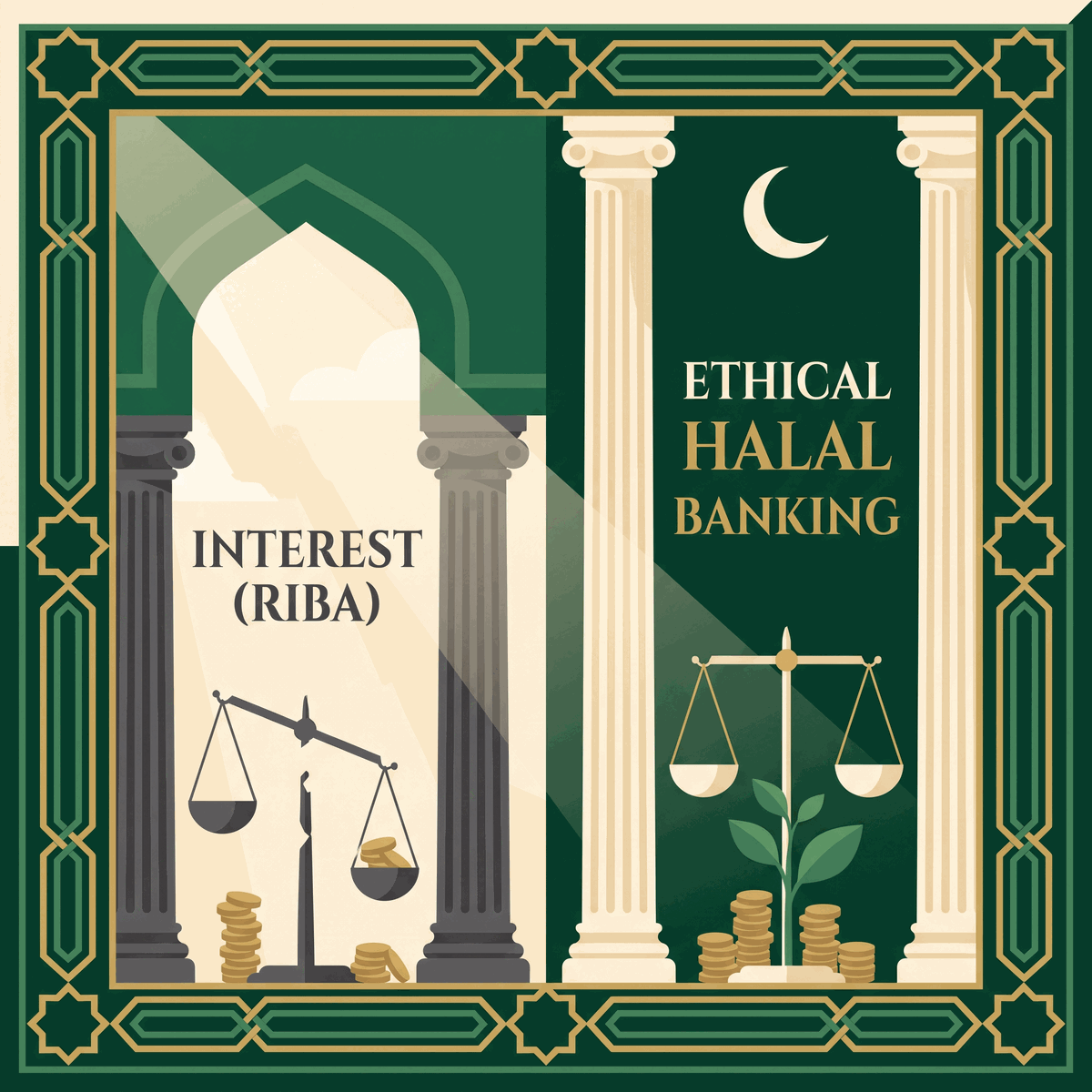
How can modern Muslims navigate daily financial needs—such as buying a home, saving for the future, or funding a business—while keeping their earnings completely free from prohibited interest? Understanding the Islamic ruling on riba (interest or usury) and learning about halal banking alternatives is essential for every Muslim seeking spiritual peace and financial integrity. This guide explains why interest is strictly forbidden in Islam and highlights practical, sharia-compliant financial solutions for your everyday life.
Understanding Riba: The Islamic Ruling and Prohibitions
In Islamic jurisprudence, riba literally means excess, increase, or addition. In financial matters, it refers to any unjustifiable increase charged or received in loans or exchanges of money. Classical scholars divide riba into two primary forms: riba al-nasi'ah (interest charged on loans or delayed debt repayments) and riba al-fadl (an unlawful excess in the immediate exchange of specified commodities of the same type). Modern conventional interest rates—whether on savings accounts, personal loans, or mortgages—fall squarely under riba al-nasi'ah.
The prohibition of riba in Islam is absolute and ranks among the most severe prohibitions in divine law. Allah Almighty explicitly highlights the distinction between trade and interest in the Qur'an:
"Allah has permitted trade and forbidden riba." (Qur'an, Al-Baqarah 2:275)
The Qur'an further warns those who persist in taking interest that they risk forfeiting divine blessing and placing themselves in conflict with Allah and His Messenger (Qur'an, Al-Baqarah 2:278-279). In the Sunnah, the Prophet Muhammad ﷺ counted interest among the seven destructive sins (Sahih al-Bukhari, Hadith 2766). Furthermore, Jabir reported that the Messenger of Allah ﷺ cursed the one who accepts interest, the one who pays it, the one who records it, and the two witnesses to the transaction, stating that they are all equal in sin (Sahih Muslim, Hadith 1598).
The economic wisdom behind prohibiting riba lies in social justice. Interest guarantees a profit for the lender regardless of whether the borrower succeeds or fails, creating an unfair concentration of wealth. It treats money as a commodity that generates more money through the mere passage of time, rather than rewarding productive work, genuine risk, or real asset creation.
How Islamic Banking Differs from Conventional Banking
The essential difference between conventional banking and halal Islamic banking lies in the fundamental nature of money and contract structures. Conventional financial institutions operate on a debtor-creditor relationship, profiting from the interest differential between money borrowed and money lent.
In contrast, Islamic banking is grounded in real economic assets, ethical trade, and risk-sharing principles. Money in Islam is viewed not as a commodity to be bought and sold, but purely as a medium of exchange and a unit of measure. In classical Hanafi jurisprudence, jurists emphasize that time alone cannot be sold for money in a loan transaction; financial gain is only justified when tied to productive effort, ownership liability (daman), or risk-bearing capital investment.
| Feature | Conventional Banking | Islamic Banking |
|---|---|---|
| Core Principle | Lending money on interest | Trading physical assets or equity risk-sharing |
| Monetary Nature | Money is a money-generating commodity | Money is a medium of exchange |
| Risk Allocation | Risk shifted primarily to borrower | Risk shared between institution and client |
| Earning Basis | Fixed or floating interest rate | Profit margin from trade or profit-loss share |
Please note that financial figures and contractual examples provided here are for illustrative purposes; Muslims should verify current market conditions and consult a qualified Islamic scholar or financial advisor regarding their specific personal circumstances. You can also calculate your annual zakat obligation accurately using our online Zakat calculator.
Core Halal Alternatives in Islamic Finance
To replace interest-based mechanisms, Islamic finance utilizes real trade and equity contracts approved by scholars across the major Sunni schools of thought. The most common sharia-compliant financial alternatives include:
- Murabaha (Cost-Plus Sale): This is one of the most widely used structures for home or asset financing. The bank purchases an asset (such as a house or vehicle) directly from a vendor at a known price, then resells it to the customer at an agreed cost plus a transparent profit markup. The customer pays this fixed total in scheduled monthly installments.
- Ijara (Lease-to-Own): Similar to conventional leasing, the bank buys an asset and leases it to the client for an agreed monthly rental fee. In an Ijara wa Iqtina structure, ownership of the asset transfers to the client at the end of the lease term through a sale or gift contract.
- Musharaka (Partnership Financing): A joint venture where both the institution and the customer contribute capital toward an enterprise or property. Profits are distributed according to an agreed ratio, while losses are shared strictly according to capital contributions. In home financing, Diminishing Musharaka allows the customer to gradually buy out the bank's share over time.
- Mudarabah (Trust Investment): A partnership between an investor providing capital (rab al-mal) and an entrepreneur providing expertise (mudarib). Profits are shared as agreed, while financial losses fall on the capital owner, provided there was no negligence.
- Qard al-Hasan (Benevolent Loan): An interest-free loan offered purely for social welfare or community goodwill, where the borrower repays only the principal amount borrowed.
Practical Steps for Managing Daily Halal Finances
Navigating contemporary financial systems while maintaining halal standards requires conscious planning and practical strategies:
- Opt for Interest-Free Checking Accounts: Choose bank accounts that do not pay interest on balance holdings.
- Cleanse Unavoidable Interest: If interest is credited to your bank account automatically, calculate the exact interest portion and donate it to charitable causes without expecting spiritual reward (sadaqah without thawab).
- Perform Halal Stock Screening: When investing in financial markets, ensure companies pass sharia screening criteria—avoiding businesses in alcohol, gambling, pork, or conventional financial services, as well as firms with excessive interest-bearing debt.
- Consult Local Scholars and Windows: In multi-religious contexts like Mauritius, look for local Islamic financial windows, halal cooperative credit societies, or consult qualified ulama to review specific loan or investment contracts before signing.
By actively seeking halal alternatives, Muslims safeguard their wealth, build resilient community partnerships, and uphold divine commands in their economic lives.
Summary Takeaway
Avoiding riba is a foundational duty that protects both individual spiritual well-being and wider economic fairness. Embracing halal banking solutions ensures that your financial growth carries true barakah (blessing), aligning your daily livelihood with Islamic values.
Frequently Asked Questions
How should I handle bank interest that is automatically deposited into my account?
Interest deposited automatically should be isolated and given away entirely to public charities or needy individuals. Because this money was earned through prohibited interest, it cannot be used for personal living expenses, taxes, or asset maintenance, and no spiritual reward should be expected for giving it away.
Is paying a higher price for deferred installment payments considered riba?
No. In Islamic law, a vendor is allowed to set a higher price for goods sold on deferred payment terms (such as in a Murabaha contract), provided the final total price and installment schedule are clearly fixed and agreed upon at the time of contract execution.
How does an Islamic home mortgage differ from a conventional interest-based loan?
A conventional mortgage is a money-for-money loan where interest accumulates on the balance over time. An Islamic home transaction involves the financial institution purchasing or co-owning the physical property and selling or leasing it to you at a fixed price or rental rate, tying all financial gains to tangible asset ownership rather than debt interest.
Sources
- Qur'an, Surah Al-Baqarah (2:275-279)
- Sahih al-Bukhari, Hadith 2766
- Sahih Muslim, Hadith 1598
- https://quran.com/al-baqarah/275
- https://sunnah.com/muslim:1598