
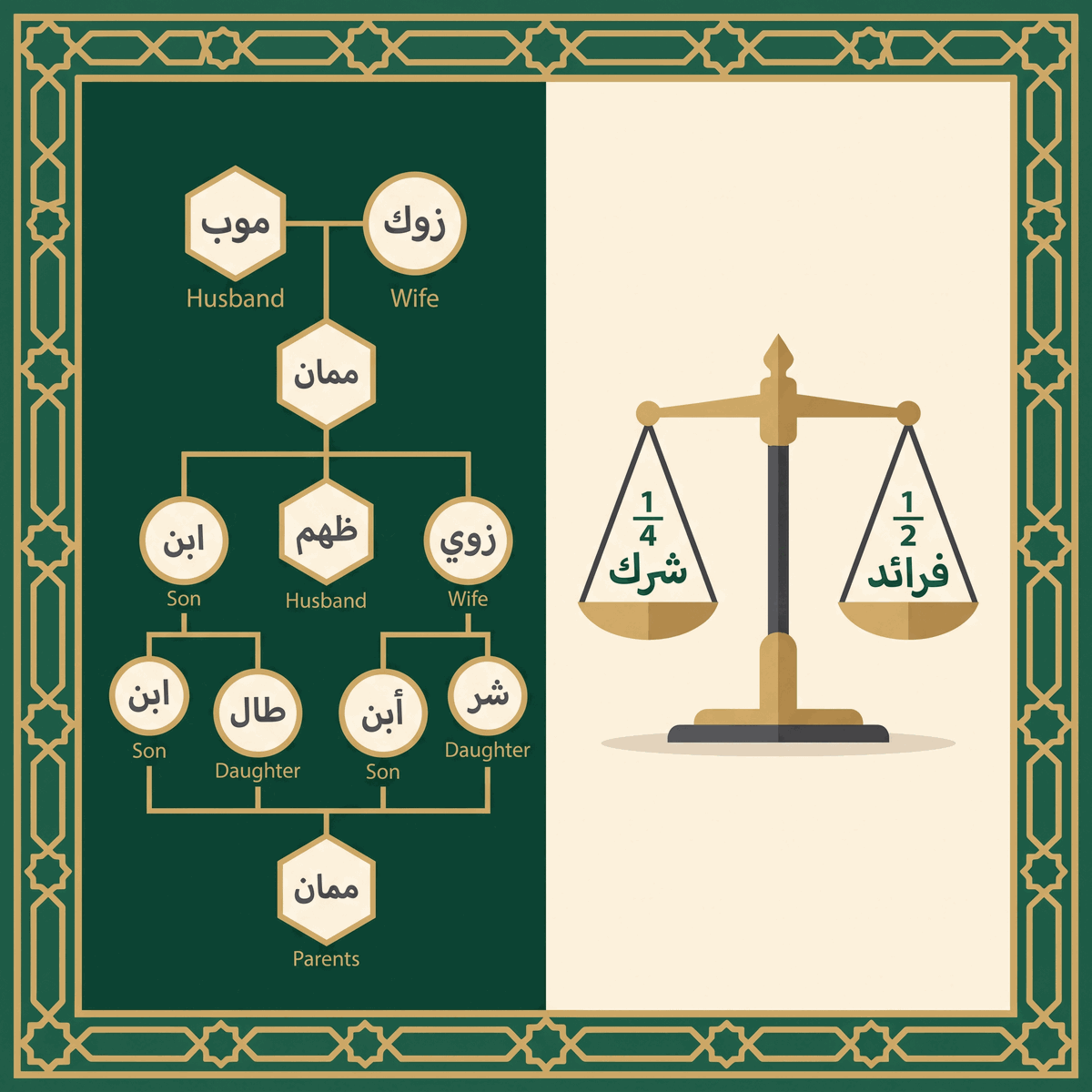
Navigating the loss of a loved one brings both emotional grief and practical responsibilities, among which the fair distribution of estate assets is paramount. In Islam, estate division is not left to personal preference or arbitrary decisions; rather, Allah Has revealed a divine framework known as Fara'id (Islamic inheritance law) to ensure justice and protect family harmony. Understanding these principles helps Muslims fulfill their sacred duty and honour their family's legacy in accordance with Shariah.
The Divine Origin and Spiritual Weight of Fara'id
Unlike many civil legal systems that allow individuals complete freedom to disinherit family members or arbitrarily allocate assets, Islamic inheritance is established directly by Allah. The detailed rulings governing inheritance are detailed primarily in Surah An-Nisa (Qur'an, An-Nisa 4:11-12 and 4:176). Because these shares are explicitly commanded by the Creator, adhering to them is considered an act of worship and religious duty.
Prophet Muhammad (ﷺ) placed immense emphasis on learning and teaching the rules of inheritance, describing them as an essential branch of sacred knowledge. He said: "Learn the laws of inheritance and teach them to the people, for it is half of knowledge" (Sunan Ibn Majah, Hadith 2719). By establishing fixed shares, Islam eliminated pre-Islamic customs that deprived women, orphaned children, and elderly parents of financial security, establishing an equitable system built on divine wisdom.
The Four Sequential Stages of Estate Distribution
Before any heir receives a single rupee or property share, the estate of a deceased Muslim must pass through four distinct sequential stages. Skipping or misordering these steps violates Shariah principles:
- Funeral and Burial Expenses: The immediate, reasonable costs of washing, shrouding, and burying the deceased are deducted from the estate. These expenses must be modest and free from extravagance.
- Settlement of Debts: All outstanding financial debts must be paid in full. This includes debts owed to people (such as commercial loans, unpaid dowry/mahr, or personal loans) and religious liabilities owed to Allah (such as unpaid Zakat or unfulfilled fidyah).
- Execution of the Wasiyyah (Will): The deceased may leave a voluntary bequest (wasiyyah) for charitable causes or individuals who are not automatic Quranic heirs (such as adopted children or non-inheriting relatives). However, Shariah strictly limits this bequest to a maximum of one-third (1/3) of the net remaining estate after debts (Sahih al-Bukhari, Hadith 2742). Furthermore, a bequest cannot be made to an existing Quranic heir, as Prophet Muhammad (ﷺ) affirmed: "Allah Has given every rightful person their due right, so there is no bequest for an heir" (Sunan Abu Dawud, Hadith 2870).
- Distribution of Fara'id: Whatever net asset remains after funeral costs, debts, and the valid wasiyyah are settled is distributed among the legitimate Quranic heirs according to their fixed legal shares.
Categories of Heirs and Quranic Shares
Islamic jurisprudence divides eligible legal heirs into distinct categories to ensure every close relative receives an appropriate portion based on their relationship and financial responsibilities:
- Quranic Sharers (Ashab al-Furud): These are individuals whose specific fractional shares are explicitly ordained in the Qur'an. There are twelve such relatives in total—including parents, husband, wife, daughters, and sisters. Quranic fractions include 1/2, 1/4, 1/8, 2/3, 1/3, and 1/6 depending on the presence or absence of children and other relatives.
- Residuaries (Asabah): These are relatives who receive the remainder of the estate after all fixed Quranic sharers have received their shares. Male relatives such as sons, fathers, or brothers often act as residuaries. The Messenger of Allah (ﷺ) instructed: "Give the fixed shares to those who are entitled to them, and whatever remains goes to the nearest male relative" (Sahih al-Bukhari, Hadith 6732).
In the Hanafi school of thought—followed by the majority of Muslims in Mauritius—if fixed shares are distributed and no residuaries exist, any surplus estate returns proportionally to the Quranic sharers (excluding spouses) under the doctrine of Radd (return). If no Quranic sharers or residuaries exist, extended relatives (Dhawu al-Arham) inherit before the estate reaches the public treasury (Bayt al-Mal). Other Sunni schools of jurisprudence hold slightly differing views regarding the precise ordering of extended relatives and public treasury allocation.
Understanding Financial Responsibilities and Common Misconceptions
A frequently discussed aspect of Fara'id is the allocation ratio between male and female heirs in certain scenarios, such as a son receiving twice the share of a daughter (Qur'an, An-Nisa 4:11). In Islamic law, financial rights are directly tied to financial obligations (nafaqah).
A Muslim woman retains absolute personal ownership over her inherited wealth, with no legal obligation to spend a single rupee on her family, husband, or household expenses. Conversely, a Muslim man is religiously required to fully maintain his wife, children, aging parents, and unmarried sisters. Therefore, the higher share allocated to a male heir in certain cases reflects his heavy financial duties under Shariah rather than superior status. In fact, in several situations—such as parents inheriting alongside children—mothers and fathers receive equal fractions (1/6 each).
Please note that figures, fractional examples, and estate calculations provided in Islamic literature are illustrative. Because every family structure is unique, readers should consult a qualified local Islamic scholar or mufti and review outstanding financial obligations—using tools like our site's Zakat calculator—before final estate settlement.
In a modern legal context, such as in Mauritius, Muslims should ensure their legal estate planning aligns with Shariah guidelines so that property transfers upon death respect Islamic inheritance principles without creating administrative conflicts.
Frequently Asked Questions
Can a person alter Islamic inheritance shares in a legal will?
No. In Islamic jurisprudence, a person cannot use a legal will (wasiyyah) to alter the fixed Quranic shares of legitimate heirs or to disinherit a relative entitled by Allah to inherit. A wasiyyah is restricted to a maximum of one-third of the net estate and can only be designated for non-inheriting individuals or charitable causes.
What happens if the deceased owed unpaid Zakat or financial debts?
Debts take precedence over inheritance distribution. Before any money or property is given to heirs, all commercial debts, personal loans, and religious liabilities (such as unpaid Zakat or mahr) must be paid from the estate. If debts equal or exceed the estate's total value, the entire estate goes toward paying off creditors.
Is a bequest (wasiyyah) permitted for a non-Muslim relative?
Yes, according to the majority of scholars, a Muslim may make a voluntary bequest (wasiyyah) of up to one-third of their net estate to a non-Muslim relative or friend who does not qualify as a direct Quranic heir, provided the bequest does not support anything forbidden in Islam.
Preserving Family Unity Through Sacred Guidance
Fulfilling the laws of Fara'id is a vital trust that safeguards harmony, guarantees individual rights, and honors the commands of Allah. By settling debts promptly, executing valid bequests, and distributing remaining assets according to divine guidance, Muslim families can transform estate settlement from a potential source of conflict into an act of enduring worship and righteousness.
Sources
- Qur'an, Surah An-Nisa 4:11-12, 176
- Sahih al-Bukhari, Hadith 2742
- Sunan Ibn Majah, Hadith 2719
- Sunan Abu Dawud, Hadith 2870
- https://quran.com/an-nisa/11-12