
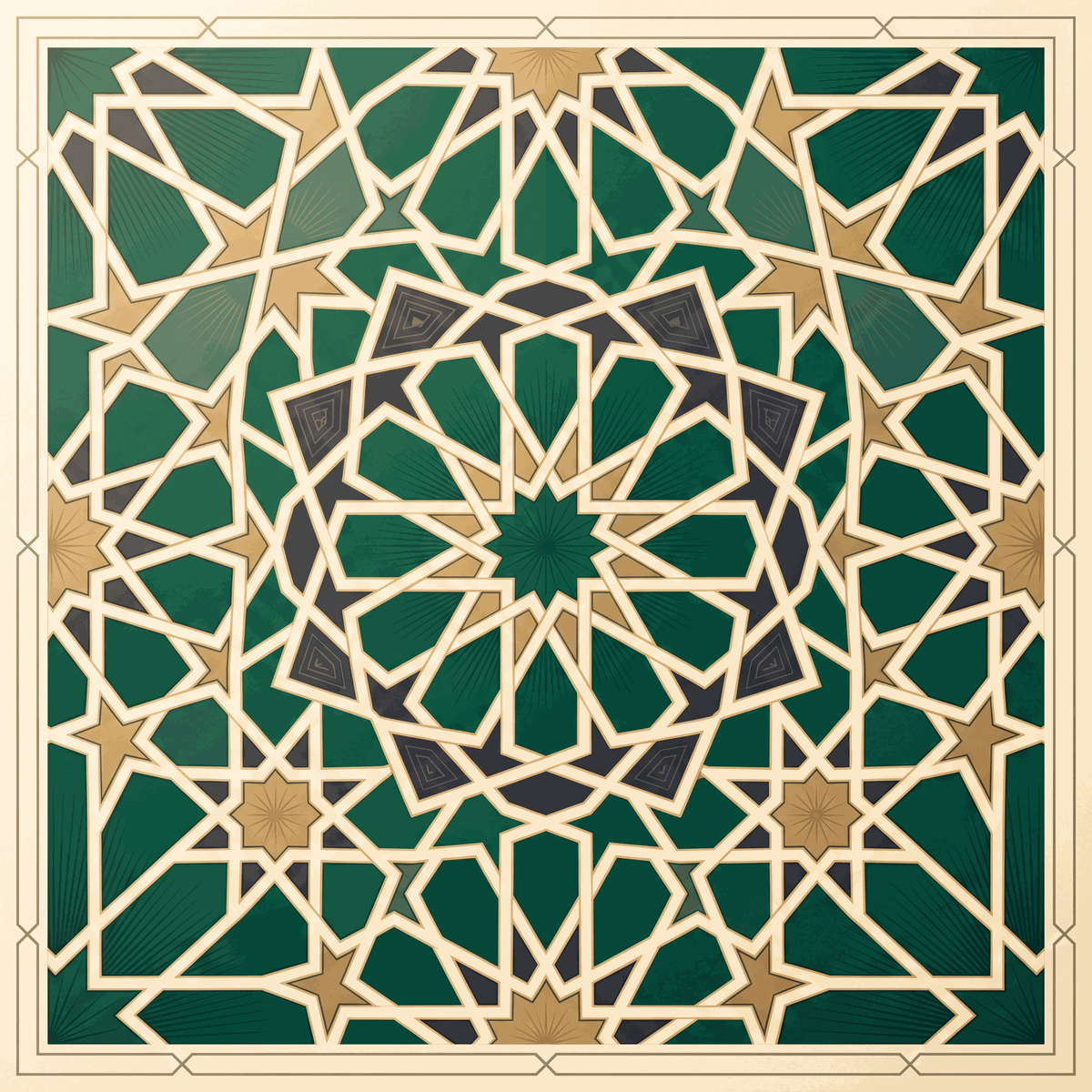
Have you ever stared at the intricate mosaic tiles or carved wooden screens in a mosque and wondered how simple shapes transform into breathtaking works of art? Far from being mere decoration, geometric patterns in Islamic art offer a quiet pathway to spiritual reflection. By turning abstract mathematical shapes into expressions of harmony and order, Muslim master artisans created a visual language that points directly to the beauty, perfection, and oneness of the Creator.
The Spiritual Foundations of Geometry in Islamic Art
In mainstream Sunni Islamic tradition, sacred spaces emphasize the absolute transcendence and uniqueness of Allah (Tawhid). To preserve pure monotheism and avoid any form of idol worship, classical Islamic architecture avoided human and animal depictions in mosques and religious texts. In their place, Muslim artisans cultivated three sacred decorative forms: Arabic calligraphy, vegetal arabesques, and geometric patterns.
Geometry in Islamic art is deeply tied to the concept of divine order (Mizan). The starting point for almost every complex geometric grid is the simple circle. In Islamic aesthetics, the circle represents unity, perfection, and the ultimate source of all creation, having no beginning and no end. By dividing a circle using basic tools—a straightedge ruler and a pair of compasses—artisans generated squares, stars, pentagons, and hexagons.
This mathematical progression symbolizes how the universe, with all its boundless diversity, emerges from a single divine source. As Allah tells us in the Qur'an regarding the flawless harmony of the cosmos: "[He] who created seven heavens in layers. You do not see in the creation of the Most Merciful any inconsistency. So return your vision [to the sky]; do you see any breaks?" (Qur'an, Al-Mulk 67:3).
The Genius of Girih Tiling and Mathematical Precision
One of the greatest artistic and mathematical achievements of Islamic civilization is the development of Girih tiling. Derived from the Persian word for "knot" or "intertwining," Girih refers to complex strapwork patterns formed by interlocking geometric tiles. Emerging around the 11th and 12th centuries across Iran, Iraq, Anatolia, and Central Asia, Girih design allowed architects to cover vast architectural surfaces with self-similar, non-repeating star designs.
Historical analysis reveals that Girih patterns were constructed using a standardized set of five geometric tile shapes:
- Decagon: A ten-sided polygon with interior angles of 144 degrees.
- Pentagon: A five-sided polygon.
- Bowtie: An elongated non-convex hexagon.
- Rhombus: A diamond-like four-sided shape.
- Hexagon: An elongated six-sided polygon.
Each of these five tiles contained specific internal line segments (strapwork). When placed edge-to-edge, the tiles vanished visually, leaving behind a continuous, interwoven web of decagons and stars.
In 2007, modern scientific research published by physicists Peter Lu and Paul Steinhardt revealed that by the 15th century—such as in the Darb-i Imam shrine in Isfahan, Iran (built in 1453)—Muslim craftsmen were utilizing Girih tiles to construct quasi-crystalline patterns. These patterns possess decagonal symmetry that does not periodically repeat, a sophisticated mathematical concept that Western mathematics only formalized in the 1970s through Penrose tilings. This discovery highlighted the profound scientific intuition embedded within classical Islamic craftsmanship.
Cosmic Symbolism: From Finite Shapes to Infinite Patterns
Beyond their technical mastery, Islamic geometric designs carry profound symbolic meanings that invite contemplation during prayer and quiet study:
- Reflection of Infinity: Islamic geometric patterns are mathematically tileable, meaning they can extend infinitely in every direction. When framed within a building's wall or window, the viewer understands that the pattern does not end at the border; it continues mentally into infinity. This serves as a physical reminder that human existence is temporary and bounded, whereas Allah's knowledge, mercy, and creation are unlimited.
- Unity in Diversity: An intricate 12-pointed star pattern might contain hundreds of individual triangles, kites, and polygons. Yet, none of these shapes exists in isolation. Each tile relies on its neighbors to hold the structure together, symbolizing the unity of the Muslim community (Ummah) and the interconnected harmony of all created things.
- Light and Spiritual Elevation: Geometric screens—known as jaali or mashrabiya—filter sunlight into delicate patterns of light and shadow across mosque carpets. As the sun moves across the sky, the illuminated geometry gently changes, reminding believers of the passage of time and the constant presence of divine light.
As Allah reminds us: "And to Allah belongs the east and the west. So wherever you turn, there is the Face of Allah" (Qur'an, Al-Baqarah 2:115).
Islamic Geometry in Mauritius and Contemporary Spaces
In Mauritius, the influence of classical Islamic geometry can be seen in masajid and cultural landmarks across the island. Reflecting the rich heritage brought by early Muslim settlers from the Indian subcontinent and the broader Indian Ocean rim, Mauritian mosque architecture blends traditional Indo-Islamic and Ottoman geometric elements.
The historic Jummah Mosque in Port Louis features beautiful carved wooden doors, geometric plaster lattice work, and marble floor accents that incorporate traditional star motifs. Across neighborhood masajid in towns like Rose Hill, Curepipe, and Phoenix, contemporary builders continue this tradition by incorporating geometric tilework, laser-cut metal screens, and stained-glass star designs.
Bringing simple geometric art or wall hangings into Mauritian homes serves as an elegant, meaningful decor choice. Sitting in a room adorned with subtle geometric patterns provides a visual point of focus that encourages mindfulness, dhikr (remembrance of Allah), and appreciation for the order present in nature.
Islamic geometric patterns are much more than technical mastery; they are silent sermons crafted in tile, stone, and wood. When we look closely at these endless shapes, we are invited to pause, remember Allah's perfect design, and find peace in the harmony of the universe.
What is the meaning of the eight-pointed star in Islamic art?
The eight-pointed star, known as the Rub el Hizb, is formed by overlapping two squares at a 45-degree angle. In Islamic artistic tradition, it symbolizes balance, spiritual progression, and order. It is frequently used in Quranic manuscripts to mark the end of a section (hizb) and appears widely across mosque architecture.
Why does Islamic art refrain from depicting human figures in mosques?
To protect the purity of worship and maintain absolute focus on the Creator (Tawhid), Islamic tradition avoids depicting human or animal figures in sacred spaces. Instead, artisans elevated geometry, calligraphy, and floral motifs (arabesques) into world-class artistic forms that convey spiritual concepts without the risk of image veneration.
How can beginners learn to draw traditional Islamic geometric patterns?
Drawing Islamic geometry requires only basic, accessible tools: a pencil, a straightedge ruler, and a drawing compass. By beginning with a single circle and drawing intersecting lines across equal divisions, anyone can construct complex six-pointed, eight-pointed, or twelve-pointed star tessellations at home.
Sources
- Metropolitan Museum of Art - Geometric Patterns in Islamic Art
- Lu, P. J., & Steinhardt, P. J. (2007). Decahedral and Quasi-Crystalline Tilings in Medieval Islamic Architecture. Science, 315(5815), 1106-1110
- Art of Islamic Pattern Resource Center
- Qur'an, Al-Mulk 67:3-4