
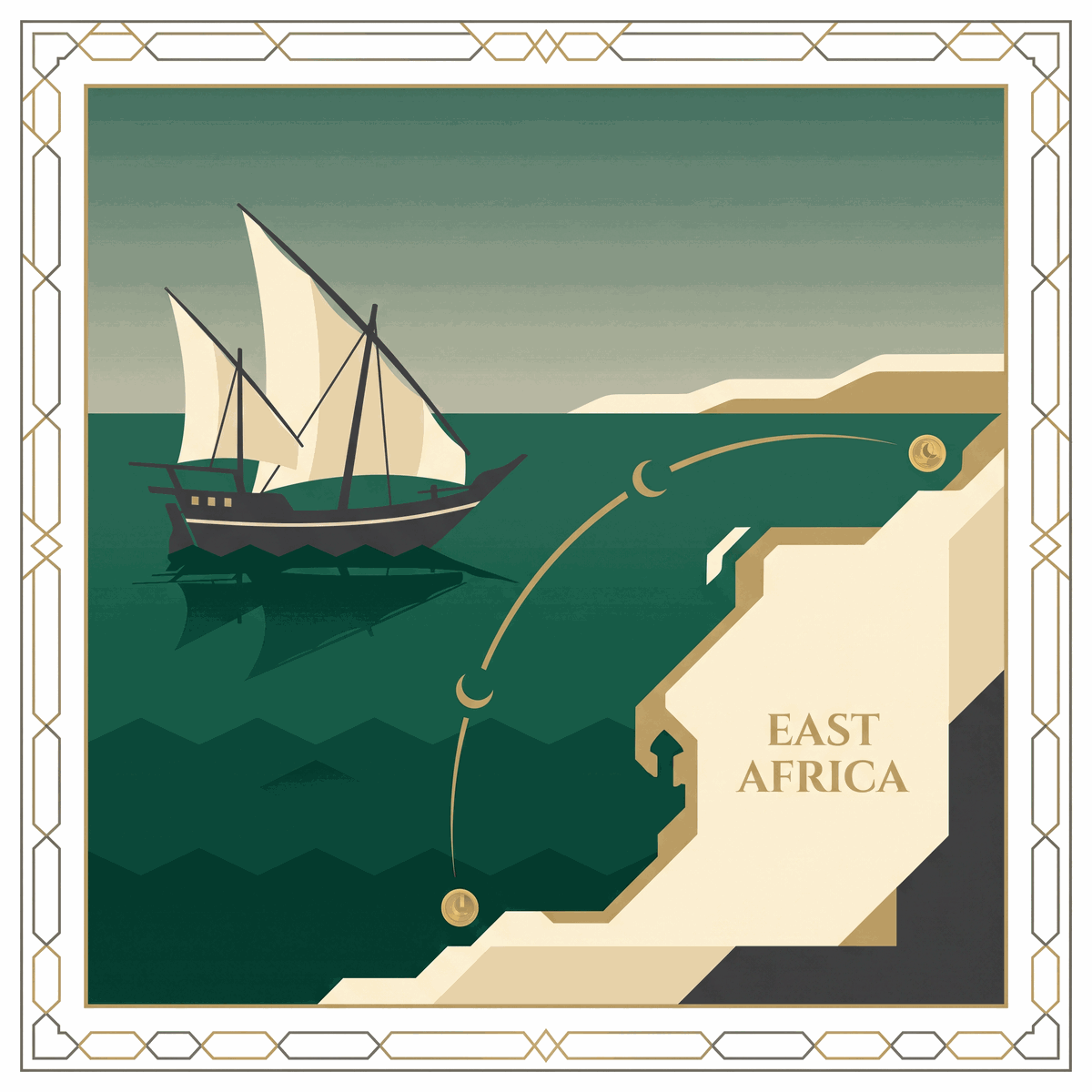
How did Islam travel across thousands of miles of ocean to establish deep roots along the East African coast and islands of the Indian Ocean without military conquest? For Muslims in Mauritius—an island whose history is intrinsically connected to the maritime trade of the region—exploring this history offers profound insights into our shared heritage. The story of Islam's spread across the Indian Ocean is a remarkable journey of faith, trade, noble character, and cultural synthesis.
The Monsoon Winds and the Dawn of Maritime Trade
Long before modern navigation tools existed, sailors and merchants understood the rhythm of the Indian Ocean. The monsoon wind system governed maritime travel for centuries. Between November and March, the kaskazi winds blew southwest toward Africa, carrying wooden dhows from Arabia, Persia, and Western India. From April to October, the kusi winds reversed, carrying sailors safely back home.
Muslim traders began utilizing these seasonal trade routes as early as the 7th and 8th centuries CE. Following the establishment of early Islamic dynasties, Muslim merchants from Oman, Yemen, the Persian Gulf, and Gujarat established trading settlements along the East African coastline—a region known as the Swahili Coast, extending from modern Somalia to Mozambique.
Unlike conquests in other regions, Islam arrived in East Africa in the luggage of merchants. Traders sought valuable commodities such as gold, ivory, timber, spices, and mangrove poles, bringing silk, ceramics, glass, and ironware in exchange. Because these merchants spent months waiting for the seasonal winds to shift, they settled in coastal ports, built homes, married local women, and established the first Muslim communities along the African rim. Archaeological findings at Shanga on Pate Island in Kenya reveal timber and coral mosque structures dating back to the 8th century, demonstrating the early arrival of Islam in the region.
The Emergence of Swahili Islamic Civilization
As Muslim traders integrated with local Bantu-speaking populations, a unique and flourishing urban culture emerged along the coast: the Swahili civilization. The word "Swahili" itself originates from the Arabic word sawahil, meaning "coasts" or "shores." The Swahili language developed as a Bantu language enriched with a significant vocabulary of Arabic terms, written initially using the Arabic script.
By the 12th century, independent coastal city-states had blossomed into wealthy, vibrant centers of maritime commerce. Key trading hubs included Kilwa Kisiwani, Zanzibar, Mombasa, Lamu, and Mogadishu. Kilwa, in particular, grew into a magnificent city-state that minted its own coinage and erected grand coral stone architecture, including the Great Mosque of Kilwa.
When the famous Moroccan traveler Ibn Battuta visited Kilwa in 1331 CE, he described it as one of the most beautiful and well-built cities in the world. He praised its ruler, Sultan al-Hasan ibn Sulaiman, for his deep piety, humility, generosity to scholars, and devotion to the Sunni tradition. Ibn Battuta noted that the local population lived with high moral standards, gathered regularly in stone mosques for congregational prayers, and maintained extensive trade relations across the Indian Ocean basin.
Extending Across the Waters: From Comoros to the Mascarene Region
The maritime trade routes did not stop at the African mainland. Seeking new trading posts and commodities, Muslim mariners navigated further southeast into the islands of the Indian Ocean. Islam established firm roots in the Comoros archipelago as early as the 10th century, where local sultanates developed strong economic and cultural ties with both the Swahili coast and Southern Arabia. Islam also spread to the northern coastal areas of Madagascar.
Arab cartographers and mariners carefully charted these waters. Famous Arab navigators, such as Ahmad ibn Majid in the 15th century, compiled detailed nautical guides (rahmani) documenting the currents, reefs, and islands of the Indian Ocean. Arab charts from this era designated the Mascarene Islands—including Mauritius—under names like Dina Arobi (Abandoned Island or Silver Island).
While Mauritius remained uninhabited until European settlement centuries later, these early Muslim navigators pioneered the very trade and shipping lanes that later defined the island's strategic importance. The movement of Indian and East African workers, merchants, and scholars to Mauritius in the 18th and 19th centuries was a continuation of this centuries-old Indian Ocean exchange, linking Mauritian Muslims directly to the broader history of the region.
Core Principles of Islam's Peaceful Expansion
The rapid and enduring adoption of Islam across the East African coast and Indian Ocean islands stands as historical proof of peaceful expansion. The Qur'an explicitly establishes the principle of religious freedom: "There is no compulsion in religion" (Qur'an, Al-Baqarah 2:256). The conversion of local populations occurred gradually through genuine admiration for the faith, intermarriage, social integration, and the moral conduct of Muslim merchants.
In Islamic tradition, commercial integrity is considered a high act of worship. The Prophet Muhammad (peace be upon him) emphasized honesty in business, stating: "The truthful, trustworthy merchant is with the prophets, the truthful ones, and the martyrs" (Sunan al-Tirmidhi, Hadith 1209; graded hasan). Muslim merchants along the Swahili coast built a reputation for fairness, keeping contracts, and refraining from deception. The Qur'an reminds believers: "O you who have believed, do not consume one another's wealth unjustly but only [in business] by mutual consent" (Qur'an, An-Nisa 4:29).
Furthermore, Islam offered a universal social framework that transcended tribal boundaries. Its emphasis on equality before God, justice, cleanliness, and brotherhood appealed strongly to diverse coastal communities. Over centuries, Islam became the spiritual and cultural foundation of the Indian Ocean world, fostering a cosmopolitan identity that welcomed visitors from every shore.
The history of Islam's expansion across East Africa and the Indian Ocean reminds us that faith spreads most effectively through living examples of character, fairness, and warmth. For the Muslim community in Mauritius today, this heritage is not merely a chapter in a history book; it is a living connection to the trade routes, values, and traditions that continue to shape our island's unique cultural tapestry.
Frequently Asked Questions
How did Islam spread across the Indian Ocean without military conquest?
Islam spread along the Indian Ocean through peaceful trade, intermarriage, and diplomatic relations. Muslim merchants established permanent settlements, practiced fair dealing based on Islamic ethics, and integrated with local populations, inspiring voluntary conversion through their conduct and values.
What role did the monsoon winds play in the spread of Islam?
The seasonal monsoon winds dictated maritime travel in the Indian Ocean. Merchants sailed to East Africa with winter winds and had to wait several months for summer winds to return home. During these long stays, Muslim traders built mosques, married locally, and introduced Islamic culture and practices.
What connection does Mauritius have to these ancient trade routes?
Arab and Muslim navigators were among the earliest mariners to chart the Mascarene Islands, naming Mauritius Dina Arobi. The maritime trade routes established during this era later connected East Africa, India, and the Mascarene islands, paving the way for the diverse Muslim community that lives in Mauritius today.