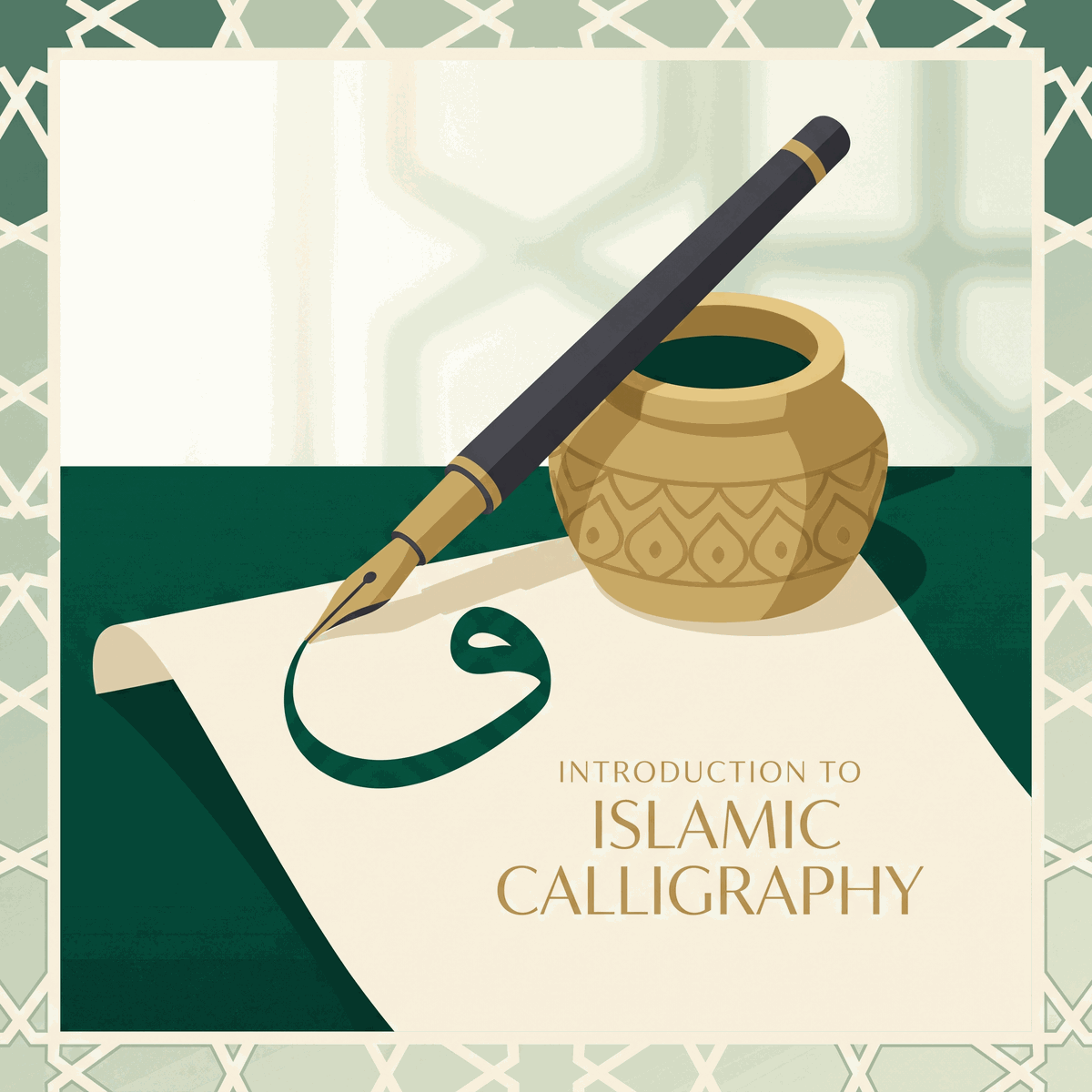
Have you ever wondered why elegant, flowing Arabic script adorns the interior walls of grand mosques, historic manuscripts, and Muslim homes across the world? Unlike many artistic traditions where human and animal figures take center stage, Islamic art elevated the written word to the highest pinnacle of visual beauty. Understanding why calligraphy became the central art form of Islam opens a fascinating window into Islamic theology, spiritual devotion, and classical aesthetics.
The Divine Word: Why Writing Became the Supreme Art Form
At the heart of Islamic calligraphy lies the foundational belief that the Holy Qur'an is the literal, verbatim Word of Allah (SWT) revealed to the Prophet Muhammad (peace be upon him). Because the Divine message was delivered in the Arabic language, copying and preserving the revelation became a sacred duty. Early Muslims approached the writing of scripture not merely as an administrative task, but as a profound act of worship (ibadah).
This spiritual imperative was anchored in the very first verses revealed to humanity in the Cave of Hira: "Read! In the Name of your Lord Who created—created man from a clinging clot. Read! And your Lord is the Most Generous—Who taught by the pen—taught man that which he knew not" (Qur'an, Al-Alaq 96:1-5). Allah SWT explicitly mentions the pen (al-qalam) as an instrument of divine knowledge and grace. Allah even swears by the pen in another chapter, stating: "Nun. By the pen and what they write" (Qur'an, Al-Qalam 68:1).
Furthermore, mainstream Islamic theology discouraged the representation of sentient beings—human and animal figures—in religious contexts to safeguard pure monotheism (Tawhid) and prevent any slip into idol worship. Rather than stifling creativity, this theological boundary channeled the artistic energy of Muslim civilizations toward scriptural expression, geometric design, and vegetal patterns (arabesque). The written word thus became the visual ambassador of faith.
The Sacred Geometry and Science of the Pen
Islamic calligraphy is far more than decorative handwriting; it is an exact mathematical science rooted in sacred geometry. Calligraphers frequently describe their craft as "geometry of the spirit expressed through the body." Over centuries, master scribes codified rigorous mathematical systems to ensure every letter maintained perfect proportion and divine harmony.
The most influential figure in this historical development was the tenth-century Abbasid vizier and calligrapher Ibn Muqla (886–940 CE). He invented al-Khatt al-Mansub (the Proportioned Script), a system based on three fundamental geometric measurements:
- The Nuqta (Rhombic Dot): A diamond-shaped dot created by pressing the square nib of a traditional reed pen (qalam) onto paper. This dot serves as the universal unit of measurement.
- The Alif: The first letter of the Arabic alphabet, constructed as a vertical line measuring a fixed number of nuqtas in height (commonly five to seven dots, depending on the script style).
- The Circle: A circle drawn with a diameter equal to the height of the Alif. Every letter's curve and proportion within that script style must fit precisely within or relate directly to this circle.
Later masters, such as Ibn al-Bawwab in the eleventh century and Yakut al-Musta'simi in the thirteenth century, refined these geometric rules. Consequently, every stroke of the pen requires immense physical control, spiritual presence, and mathematical discipline.
Major Classical Scripts and Their Unique Character
As Islamic civilization expanded across Asia, North Africa, the Middle East, and Europe, different styles of writing emerged to suit various contexts—from grand architectural monuments to official government decrees and delicate Quranic codices. Six primary scripts, known as Al-Aqlam al-Sittah (The Six Pens), became standard in the classical era.
- Kufic: Named after the city of Kufa in Iraq, Kufic is the oldest formal Arabic script. Characterized by its bold, angular, geometric letterforms, it dominated early Quranic manuscripts from the 7th to 10th centuries and remains widely featured on architectural friezes and coins.
- Naskh: Meaning "cancellation" or "copying," Naskh was developed as a supple, highly legible, rounded script that eventually superseded Kufic for transcribing books and manuscripts. Today, virtually all printed Arabic books and Qur'ans use modern adaptations of Naskh.
- Thuluth: Known as the "king of scripts," Thuluth features large, sweeping vertical lines and intricate interweaving curves. Its majestic appearance makes it the preferred script for architectural inscriptions, mosque domes, and surah titles in the Qur'an.
- Nastaliq: Developed in Persia during the 14th century, Nastaliq combines fluid diagonal sweeps with delicate short verticals. It became the dominant script for Persian, Urdu, and Ottoman poetry and decorative art.
- Diwani: Created by Ottoman scribes for royal decrees (firmans), Diwani is famous for its intricate, overlapping, and decorative loops that were deliberately difficult to forge.
Spiritual Discipline and Architectural Legacy
In the Islamic tradition, calligraphy is an extension of personal devotion. Master calligraphers historically underwent years of rigorous apprenticeship under a master scribe before receiving their ijazah (formal license to teach and sign works). The traditional calligrapher prepares by purifying their intention (niyyah), performing ritual ablution (wudu), and reciting Bismillah before dipping the reed pen into silk-saturated ink (liqa).
This reverent craft left a permanent mark on Islamic architecture worldwide. Mosques across regions—from the Umayyad Mosque in Damascus and the Alhambra in Granada to historical mosques in Mauritius such as the Jummah Mosque in Port Louis—feature calligraphic bands detailing the ninety-nine Names of Allah, verses of Ayat al-Kursi, or salutations upon the Prophet (peace be upon him). These inscriptions transform stone and wood into spiritual reminders, elevating the human heart toward the Remembrance of Allah (dhikr).
As the Prophet Muhammad (peace be upon him) said: "Verily, Allah is Beautiful and He loves beauty" (Sahih Muslim, Hadith 91). Islamic calligraphy stands as one of the most enduring testaments to this love of sacred beauty, turning ink and paper into an eternal celebration of Divine Truth.
Why is calligraphy preferred over figurative painting in Islamic art?
Islamic art prioritizes calligraphy because the primary visual focus of Muslim culture is the honor and preservation of Allah's revealed Word. By focusing on scriptural beauty rather than human or animal figures, Islamic art avoids any risk of idolatry (shirk) and creates an atmosphere centered on pure monotheism (Tawhid).
What script is most commonly used for Quranic copies today?
The most widely used script for printing the Holy Qur'an today is Naskh. Its clean, rounded, and clear letterform makes it easily readable for Muslims around the world, whether native Arabic speakers or non-native readers.
What tools are traditionally used in classical Islamic calligraphy?
Traditional calligraphers use a reed pen called a qalam (often cut from dried marsh reeds or bamboo), soot-based carbon ink (hibr), a silk thread wad (liqa) placed inside an inkwell to control ink flow, and specially treated, polished paper (aahar) that allows smooth pen movement and easy corrections.
Sources
- Metropolitan Museum of Art: Calligraphy in Islamic Art
- https://www.metmuseum.org/essays/calligraphy-in-islamic-art
- The Cosmic Script: Sacred Geometry and the Science of Arabic Penmanship by Ahmed Moustafa and Stefan Sperl
- Encyclopaedia Britannica: Islamic Calligraphy
- https://www.britannica.com/art/Islamic-calligraphy