
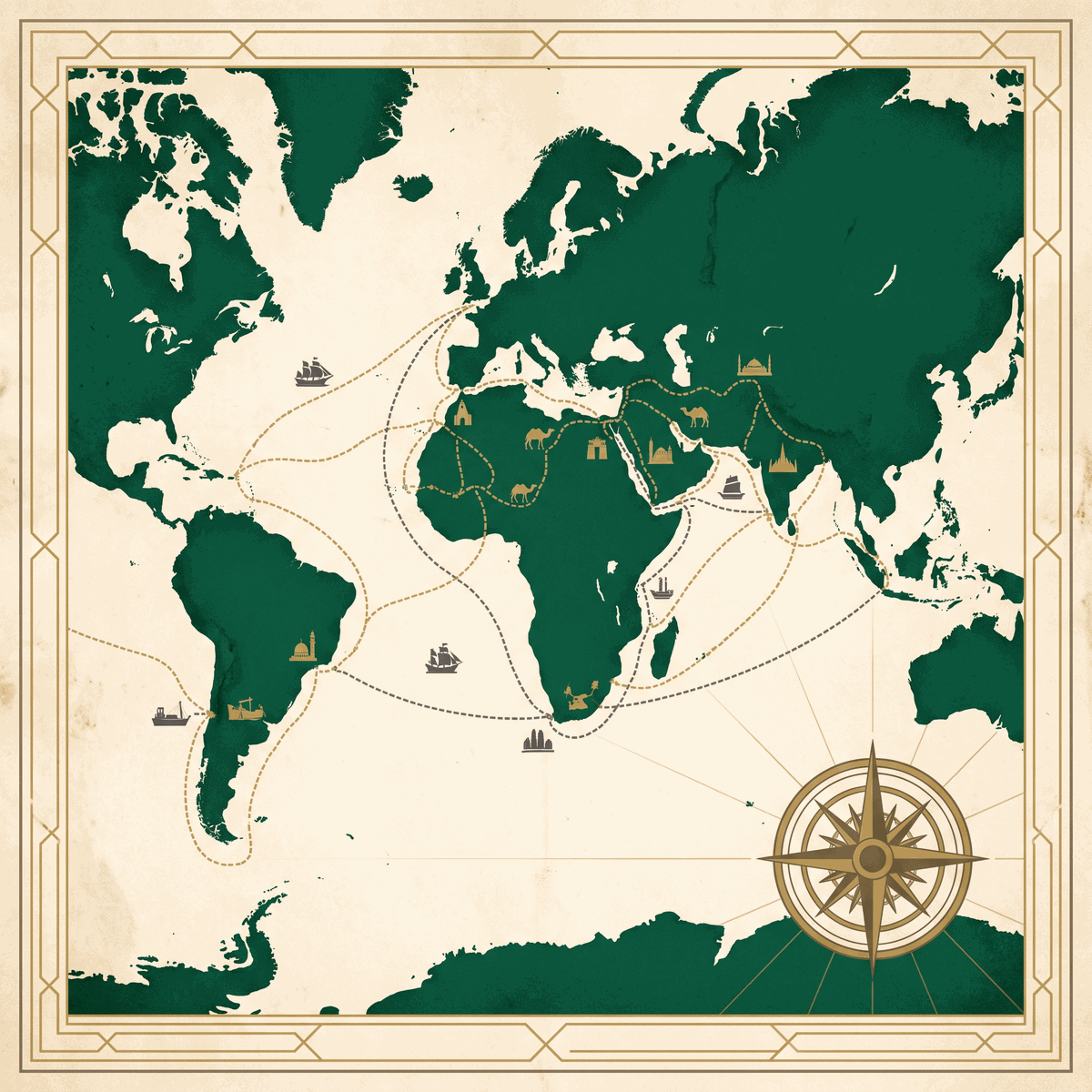
Have you ever wondered how connected the Islamic world was long before modern transport and global telecommunications? In the 14th century, a young scholar set out on a pilgrimage that evolved into one of the most remarkable travel journeys in human history. Exploring the extraordinary life of Ibn Battuta reveals how faith, scholarship, and hospitality created a vibrant, interconnected Muslim world spanning thousands of miles across Africa, Asia, and Europe.
The Spark of Departure: From Tangier to Mecca
Abu Abdullah Muhammad ibn Battuta was born in Tangier, Morocco, in 1304 CE (703 AH) into a family of Islamic legal scholars. Raised with a traditional education in Maliki jurisprudence (fiqh) and Islamic sciences, he prepared for a quiet life as a local magistrate. However, in June 1325 CE (725 AH), at the age of 21, he felt a powerful calling to fulfill his religious obligation of Hajj in Mecca.
Leaving his home mounted on a donkey, Ibn Battuta later wrote of the emotional departure from his parents, describing how he set out alone with neither companion nor caravan. What began as a sacred pilgrimage transformed into a lifelong journey driven by curiosity and devotion. His travels aligned with the Qur'anic exhortation to observe the signs of Allah throughout the world: "Say, [O Muhammad], 'Travel through the land and observe how He began creation.'" (Qur'an, Al-Ankabut 29:20).
Across Continents and Oceans: The Scope of His Travels
Ibn Battuta's journeys spanned nearly 30 years, during which he covered an estimated 73,000 miles (117,000 kilometers)—roughly three times the distance traversed by his European contemporary Marco Polo. Guided by his personal rule to never travel the same road twice whenever possible, his routes linked major civilisations across three continents.
After completing his first Hajj in 1326, he ventured through Cairo, Jerusalem, Damascus, and Baghdad. His travels then took him south along the East African coast to Mombasa and Kilwa, before turning north toward Anatolia (modern Turkey) and across the Black Sea into the territory of the Golden Horde in Central Asia.
Crossing the Hindu Kush mountains, Ibn Battuta arrived in India, where Sultan Muhammad bin Tughluq appointed him as a qadi (judge) in the Delhi Sultanate. He served in Delhi for nearly eight years before being appointed as an ambassador to China. En route, he spent over a year in the Maldives, where he again served as chief judge, helping structure local legal institutions. Continuing east, he visited Sri Lanka, Sumatra (in modern Indonesia), and reached the bustling Chinese port city of Quanzhou (known to Arab traders as Zaytoun).
Upon returning westward to Morocco in 1354 CE, he made further journeys north into Al-Andalus (Granada) and south across the Sahara Desert to the Mali Empire, visiting the famed scholarly hub of Timbuktu. Throughout his journeys, he embodied the prophetic encouragement to seek knowledge and wisdom across the earth (Sunan Ibn Majah, Hadith 224; graded sahih).
Islamic Law and the Culture of Universal Hospitality
How was a single traveler able to journey safely through dozens of foreign kingdoms in the 14th century? The answer lies in the shared legal, linguistic, and cultural fabric of Dar al-Islam (the Abode of Islam). Because Arabic served as the global language of scholarship and Islamic law (sharia) provided a common legal code, Ibn Battuta found familiar institutions wherever he traveled.
His classical legal training made him instantly employable across Islamic lands. Rulers and communities welcomed him, valuing his expertise as a judge and scholar. Furthermore, the Islamic tradition of hospitality (diyāfah) provided essential infrastructure for wayfarers. Networked throughout major trade routes were zawiyas (Sufi lodges), madrasas, and caravanserais that offered food, lodging, and protection to travelers without charge.
This institutional support reflected the Qur'anic mandate to support the wayfarer (ibn al-sabil), recognized in Islamic law as one of the deserving groups for charitable support: "Zakat expenditures are only for the poor and for the needy and for those employed to collect [zakat] and for bringing hearts together... and for the traveler." (Qur'an, At-Tawbah 9:60).
The Rihla: Preserving a Masterpiece of History
Upon his final return to Morocco in 1354 CE, Sultan Abu Inan Faris recognized the unprecedented historical value of Ibn Battuta's experiences. The Sultan commissioned an Andalusian scholar and poet, Ibn Juzayy al-Kalbi, to record the traveler's memoirs into a written narrative.
The resulting work was titled Tuhfat al-Nuzzar fi Ghara'ib al-Amsar wa Aja'ib al-Asfar ("A Gift to Those Who Contemplate the Wonders of Cities and the Marvels of Travel"), commonly known simply as the Rihla ("The Journey"). This masterpiece provided invaluable detail regarding 14th-century political court life, trade networks, religious customs, geography, and social structures. It also included vivid firsthand accounts of major historical events, including the devastating arrival of the Black Death in the Middle East.
Unlike formal court histories of the era, the Rihla captures the lived reality of everyday people across diverse cultures, demonstrating the rich pluralism within the global Muslim community.
Timeless Lessons for the Modern Muslim
The remarkable journey of Ibn Battuta offers several enduring lessons for Muslims today:
- Appreciation of Global Unity: His travels highlight how shared faith transcends ethnic, linguistic, and geographic boundaries.
- Relentless Pursuit of Knowledge: He viewed every city as a classroom, learning from local scholars, Sufi saints, and judges.
- Trust in Allah (Tawakkul): Navigating dangerous roads, pirate attacks, and illness required unwavering faith and resilience.
- Respect for Cultural Pluralism: He documented how different societies practiced Islam within their unique local customs while remaining united in core belief.
As Allah reminds humanity in the Holy Qur'an: "O mankind, indeed We have created you from male and female and made you peoples and tribes that you may know one another." (Qur'an, Al-Hujurat 49:13). Ibn Battuta lived this verse in its fullest sense, bridging worlds through curiosity and respect.
Ultimately, Ibn Battuta was more than an adventurer; he was a scholar and witness to the grandeur of medieval Islamic civilization. His journey reminds us that open-mindedness, faith, and a desire to connect with humanity are timeless virtues that continue to enrich our lives today.
FAQ: Frequently Asked Questions
How far did Ibn Battuta travel compared to Marco Polo?
Ibn Battuta traveled over 73,000 miles (117,000 kilometers) across nearly 44 modern countries, covering roughly three times the total distance recorded by Marco Polo.
What is the title of Ibn Battuta's famous travel book?
His book is officially titled Tuhfat al-Nuzzar fi Ghara'ib al-Amsar wa Aja'ib al-Asfar ("A Gift to Those Who Contemplate the Wonders of Cities and the Marvels of Travel"), commonly known simply as the Rihla.
How did Ibn Battuta support himself during his 30 years of travel?
As a qualified Islamic legal scholar (qadi), he was frequently hired by rulers and governors, received royal stipends, and relied on the traditional network of Islamic hospitality lodges (zawiyas) and charity for travelers.
Sources
- Britannica - Ibn Battuta Biography: https://www.britannica.com/biography/Ibn-Battuta
- UC Berkeley ORIAS - The Travels of Ibn Battuta: https://orias.berkeley.edu/resources-teachers/travels-ibn-battuta
- History Channel - Why Ibn Battuta May Be the Greatest Explorer: https://www.history.com/articles/why-arab-scholar-ibn-battuta-is-the-greatest-explorer-of-all-time
- (Qur'an, Al-Ankabut 29:20)