
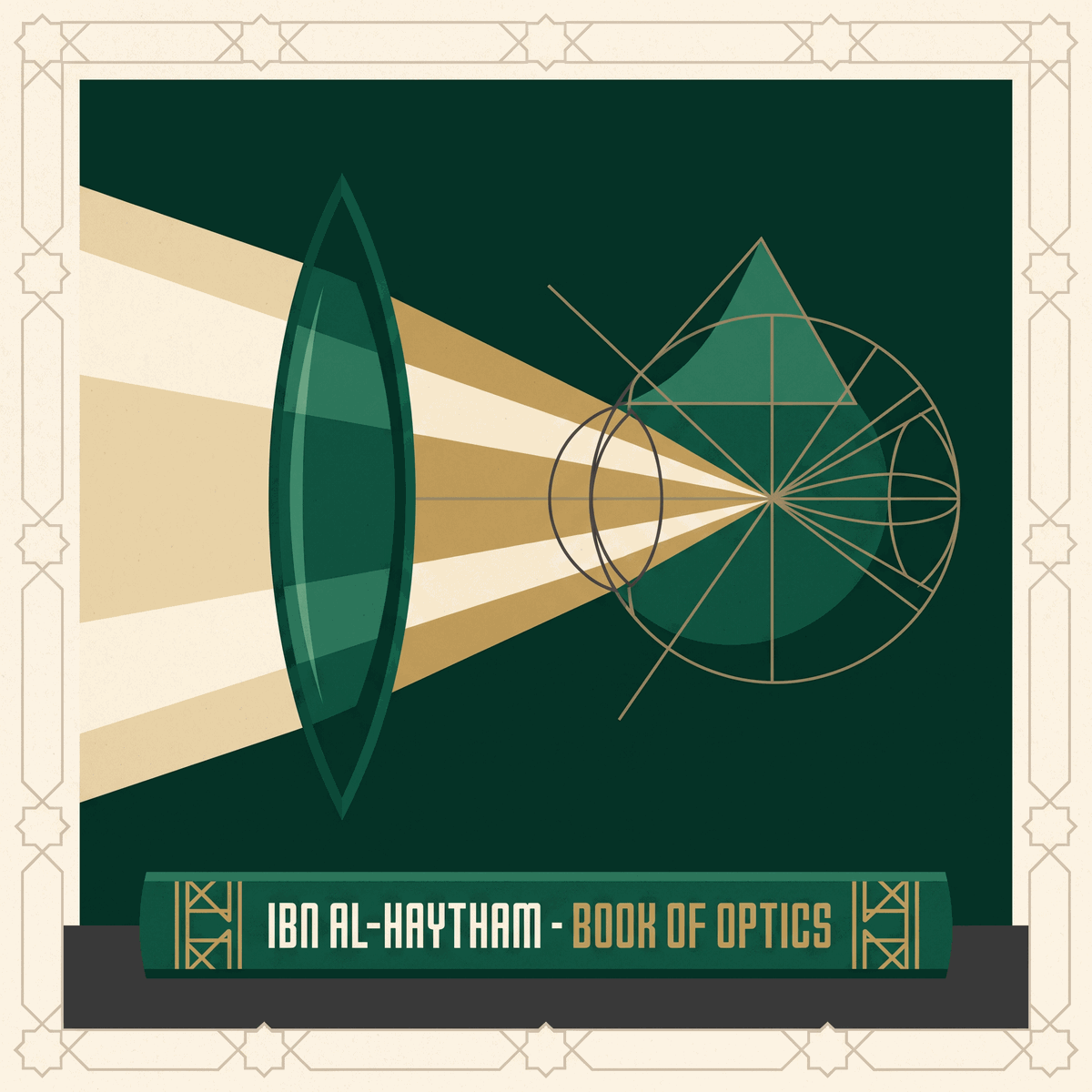
Have you ever wondered how we came to understand light, sight, and the optics that power modern eyeglasses, cameras, and telescopes? Long before the European Renaissance, an eleventh-century Muslim polymath named Ibn al-Haytham revolutionized our understanding of the physical world through groundbreaking experiments. Known in the Western world as Alhazen, his remarkable discoveries transformed optics from philosophical speculation into an exact empirical science, earning him the title of the father of modern optics.
Who Was Ibn al-Haytham? The Life of a Polymath
Born around 965 CE in Basra (in modern-day Iraq), Abu Ali al-Hasan ibn al-Hasan ibn al-Haytham grew up during the intellectual peak of the Islamic Golden Age. He was a true polymath who mastered physics, mathematics, astronomy, medicine, and Islamic jurisprudence. His exceptional talents eventually drew the attention of the Fatimid Caliph al-Hakim, who invited him to Cairo to solve a major engineering challenge: regulating the seasonal flooding of the River Nile.
Upon inspecting the river near Aswan, Ibn al-Haytham realized that controlling the Nile was technologically impossible with the tools of his era. Knowing that admitting failure to the unpredictable ruler could cost him his life, Ibn al-Haytham feigned madness. He was placed under house arrest in Cairo for ten years until the Caliph's death in 1021 CE. Far from being a defeat, this decade of confinement provided him with the uninterrupted time and quiet environment needed to perform optics experiments, culminating in his masterpiece, Kitab al-Manazir (The Book of Optics).
The Breakthrough: Overturning Ancient Theories of Vision
For more than a thousand years prior to Ibn al-Haytham, visual theory in both Europe and the Islamic world was dominated by the emission theory. Ancient Greek thinkers such as Euclid and Ptolemy argued that vision occurs because the human eye projects invisible rays of light that touch external objects. Other philosophers argued for the intromission theory—that forms leave objects and enter the eye—but lacked physical and mathematical proofs.
Ibn al-Haytham shattered the ancient emission theory using systematic observation and simple physical logic. He pointed out that looking directly at the bright sun causes severe pain and temporary blindness—an outcome that would be impossible if the eye were sending light outward. Instead, he proved that light reflects off physical objects and enters the human eye. Combining physics, mathematics, and anatomy, Ibn al-Haytham mapped the eye’s structure in detail, identifying the cornea, lens, retina, and optic nerve, thereby establishing a scientific model of sight that remains fundamental today.
The Camera Obscura and the Birth of Modern Optics
One of Ibn al-Haytham’s most famous experimental setups was the al-Bayt al-Muthlim, which translates to "the dark room"—known today by its Latin name, the camera obscura. He demonstrated that when light from a sunlit outdoor scene passes through a small pinhole into a dark room, an inverted image of the outside world is projected onto the opposite white surface.
Through meticulous testing, he established several foundational laws of light:
- Light travels in perfectly straight lines (rectilinear propagation).
- Rays of light reflect off smooth and rough surfaces according to distinct geometric angles.
- Light bends (refracts) when passing through different media, such as air, water, and glass lenses.
He conducted advanced mathematical calculations to solve complex optical problems, including "Alhazen’s problem," which determines the exact point on a spherical mirror where a light ray reflects to a viewer's eye. These breakthroughs directly paved the way for modern optical instruments, including reading lenses, microscopes, photography, and digital cameras.
Pioneering the Scientific Method Through Islamic Faith
While Ibn al-Haytham's discoveries in optics altered physics forever, his greatest legacy is his contribution to scientific methodology. Centuries before Francis Bacon, René Descartes, or Galileo Galilei, Ibn al-Haytham formalized the modern scientific method. He insisted that scientific truth cannot rely on authority, tradition, or philosophical speculation alone; it must be proven through controlled experimentation, repeated observation, and mathematical verification.
For Ibn al-Haytham, this rigorous quest for empirical truth was deeply intertwined with his Islamic worldview. He viewed the study of nature as a spiritual endeavor—a way to contemplate the divine wisdom, order, and beauty created by Allah. The Qur'an repeatedly commands believers to observe the natural universe and reflect upon its design:
"He who created seven heavens in layers. You do not see in the creation of the Most Merciful any inconsistency. So return your vision to the sky; do you see any breaks?" (Qur'an, Al-Mulk 67:3)
Guided by this Qur'anic perspective, Ibn al-Haytham famously observed that a true seeker of scientific knowledge must constantly question hypotheses, challenge assumptions, and trust only verifiable evidence.
The Lasting Legacy of Ibn al-Haytham in World Science
When Kitab al-Manazir was translated into Latin as De Aspectibus in the late twelfth century, it fundamentally reshaped Western science. European scholars such as Roger Bacon, Witelo, Johannes Kepler, and Sir Isaac Newton relied heavily on his texts to build their own theories on light, gravitation, and planetary motion.
In 2015, UNESCO celebrated the International Year of Light by recognizing Ibn al-Haytham as a central figure in the global history of science. For Muslims across the globe—and within our community here in Mauritius—Ibn al-Haytham serves as an enduring symbol of scientific excellence rooted in faith. His life demonstrates that intellectual curiosity and spiritual devotion are mutually reinforcing paths toward discovering truth.
Ibn al-Haytham’s legacy reminds us that asking critical questions, gathering empirical evidence, and studying the universe are noble pursuits that honor our heritage and enlighten our future.
FAQ
What is Ibn al-Haytham best known for?
Ibn al-Haytham is best known as the father of modern optics. He proved that vision occurs when light enters the eye, invented the principles of the camera obscura, and pioneered the empirical scientific method.
When and where did Ibn al-Haytham live?
He was born around 965 CE in Basra, Iraq, and spent much of his adult life conducting research in Cairo, Egypt, where he passed away around 1040 CE during the Islamic Golden Age.
How did Ibn al-Haytham influence Western science?
His foundational work, Kitab al-Manazir (Book of Optics), was translated into Latin in the 12th century and directly influenced European pioneers like Roger Bacon, Johannes Kepler, and Isaac Newton.