
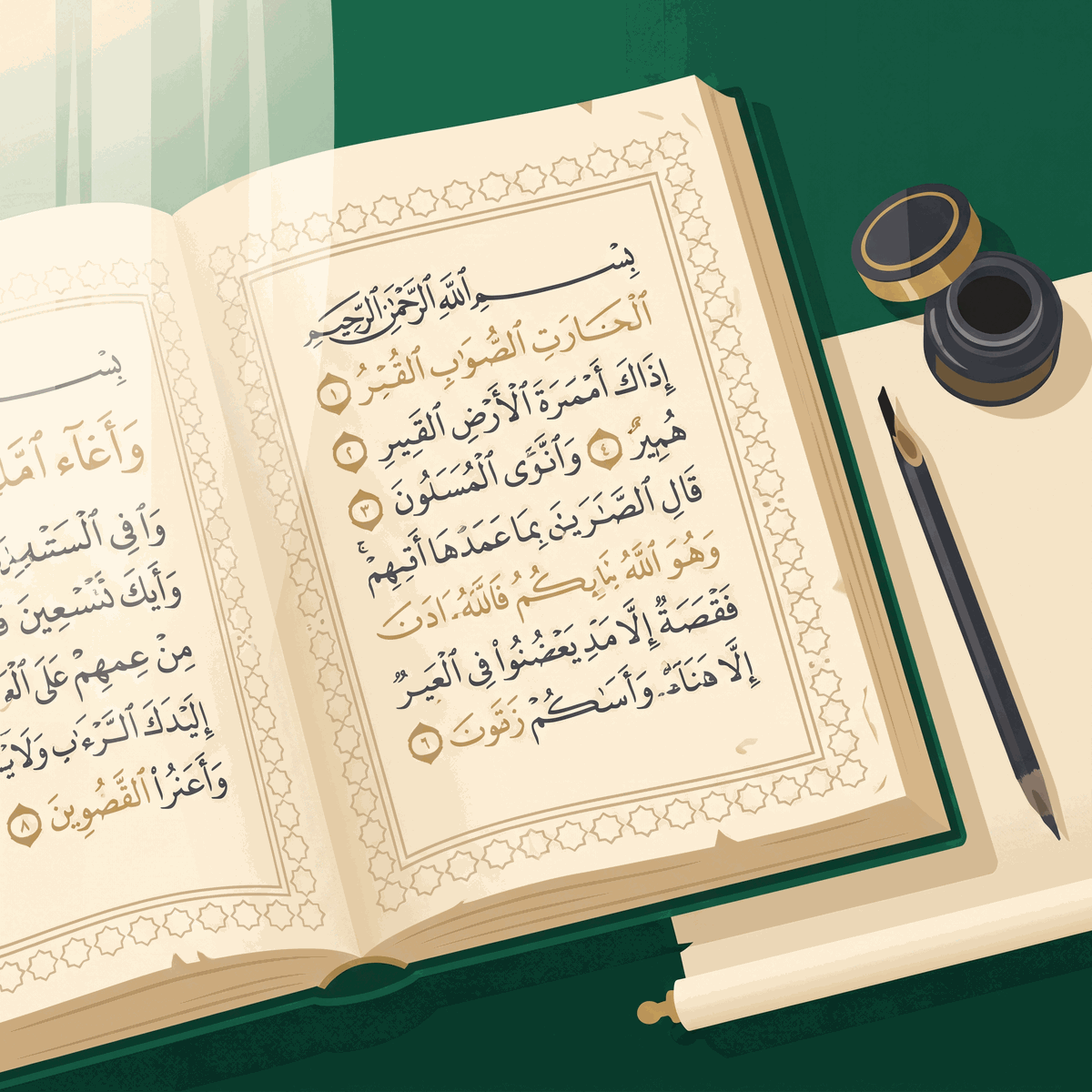
Every time you open the Qur'an or recite a verse in daily prayer, you hold in your hands a text preserved perfectly for over fourteen centuries. Many believers wonder how thousands of revealed verses were gathered from palm leaves, parchments, and memory into a single bound book (Mushaf). Understanding the historical journey of the Qur'an's compilation deepens our gratitude and strengthens our awe at Allah's divine promise of preservation.
The Oral and Written Preservation During the Prophet's Lifetime
During the twenty-three years of prophetic ministry, the Qur'an was revealed gradually to Prophet Muhammad ﷺ through Angel Jibril (Gabriel). Each revelation was met with immediate action: the Prophet ﷺ recited the verses to his Companions, who memorised them with utmost devotion. Arabia possessed an extraordinary oral culture where individuals could retain thousands of poetic lines effortlessly. This natural aptitude was transformed into a spiritual duty to safeguard the words of Allah.
Alongside oral memorisation, written documentation began during the lifetime of Prophet Muhammad ﷺ. Whenever a new passage was revealed, the Prophet ﷺ summoned designated scribes among his Companions—such as Zayd ibn Thabit (RA), Ubayy ibn Ka'b (RA), Ali ibn Abi Talib (RA), and Mu'awiyah ibn Abi Sufyan (RA). He instructed them exactly where to place each verse within its respective chapter.
Because parchment was scarce in Arabia, the Companions recorded verses on smooth stones, leather strips, shoulder blades of camels, and palm fronds. By the time of the Prophet's ﷺ passing, the entire Qur'an was fully written down on various materials and memorised in its entirety by numerous Companions (huffadh). However, it had not yet been gathered into a single bound volume, as revelations continued until shortly before the Prophet's ﷺ death. Furthermore, the annual review conducted by Angel Jibril with the Prophet ﷺ—known as al-Ardah al-Akhirah (the final review)—established the definitive arrangement of chapters and verses.
The First Official Compilation Under Caliph Abu Bakr (RA)
Following the passing of the Prophet ﷺ, Abu Bakr (RA) became the first Caliph of Islam. Shortly into his leadership, the Battle of Yamama took place during the Ridda wars. A significant number of prominent Quranic memorisers fell as martyrs on the battlefield.
Observing this tragic loss, Umar ibn al-Khattab (RA) grew deeply concerned for the long-term preservation of the written text. He approached Caliph Abu Bakr (RA) and suggested gathering all written fragments into a single, unified master copy. Initially, Abu Bakr (RA) hesitated, reluctant to undertake a task the Prophet ﷺ himself had not explicitly ordered. However, after reflection, Abu Bakr (RA) recognised the vital necessity of the project and commissioned Zayd ibn Thabit (RA), who was renowned for his exceptional intellect, immaculate memory, and experience as a primary scribe for the Prophet ﷺ.
Zayd ibn Thabit (RA) approached this monumental task with unmatched rigor and humility, stating that moving a mountain would have felt easier than compiling the Qur'an. He did not rely solely on his own memorisation or written notes. Instead, he established a strict methodology requiring two distinct pieces of evidence for every verse: oral confirmation from memorisers and written proof verified by two reliable eyewitnesses who had seen the text written in the presence of the Prophet ﷺ.
Through this exhaustive process, Zayd ibn Thabit (RA) produced the first official complete manuscript of the Qur'an on uniform sheets (suhuf). This pristine compilation was entrusted to Caliph Abu Bakr (RA). Upon his passing, it was transferred to Caliph Umar (RA), and later to Umar's daughter, Hafsah bint Umar (RA), the Mother of the Believers (Sahih al-Bukhari, Hadith 4986).
Standardization Under Caliph Uthman (RA) and Global Distribution
As Islam expanded rapidly across North Africa, Persia, and the Levant during the reign of the third Caliph, Uthman ibn Affan (RA), millions of people from non-Arabic backgrounds embraced the faith. The Qur'an had originally been revealed with permissible variations in pronunciation and dialect (ahruf) to accommodate different Arab tribes.
During military campaigns in Azerbaijan and Armenia, the noble Companion Hudhayfah ibn al-Yaman (RA) observed Muslim soldiers arguing over slight dialectical variations in recitation. Deeply concerned that these regional differences might lead to confusion or division, Hudhayfah (RA) traveled straight to Madinah and urged Caliph Uthman (RA) to unite the Muslim Ummah upon a single standardized text.
Caliph Uthman (RA) responded promptly to safeguard the unity of the community. He requested the original master manuscript from Hafsah (RA) and appointed a committee of scholars led once again by Zayd ibn Thabit (RA), alongside Abdullah ibn al-Zubayr (RA), Sa'id ibn al-'Aas (RA), and Abdur-Rahman ibn al-Harith (RA). Uthman (RA) instructed them to transcribe multiple official copies based on the original compilation, adhering strictly to the primary Quraishi dialect in which the Qur'an was revealed.
Once these master copies (Mushaf Uthmani) were completed, Uthman (RA) retained one copy in Madinah and dispatched official copies to the major Islamic learning centers, including Makkah, Kufa, Basra, and Damascus (Sahih al-Bukhari, Hadith 4987). To ensure total uniformity and eliminate future disputes, all secondary private notes and partial personal fragments were retired. This decisive leadership preserved the exact textual integrity of the Qur'an for all generations across the globe.
Divine Promise and Modern Continuity
The meticulous preservation of the Qur'an through written manuscripts and oral chains of transmission fulfills Allah's explicit declaration in the divine revelation: "Indeed, it is We who sent down the Qur'an and indeed, We will be its guardian" (Qur'an, Al-Hijr 15:9).
Unlike any other historical text, the Qur'an has remained completely unchanged for over 1,400 years. The exact order of Surahs and verses preserved by Zayd ibn Thabit (RA) and standardized by Uthman (RA) is the very text recited in mosques across Mauritius today—from Port Louis to Curepipe—and throughout the global Muslim world. Every student who memorises the Qur'an receives an ijazah (certification) linking their chain of reciters directly back to Prophet Muhammad ﷺ, securing an unbroken spiritual and scholarly legacy.
Understanding how the Qur'an was compiled reminds us that our faith rests upon unmatched historical rigor, divine protection, and the dedication of the Prophet's ﷺ noble Companions.
Frequently Asked Questions
Why was the Qur'an not compiled into a single book during the Prophet's lifetime?
The Qur'an was revealed gradually over twenty-three years to address ongoing events and guidance. Because revelation continued until shortly before the Prophet's ﷺ passing, a single bound book could not be finalized earlier. Additionally, the Companions memorised the verses as they were revealed, keeping the text fully preserved in both heart and writing.
What is the difference between Abu Bakr's compilation and Uthman's standardization?
Abu Bakr (RA) gathered all existing written fragments of the Qur'an into one comprehensive, verified master manuscript to prevent loss after many memorisers died at Yamama. Uthman (RA) took that original master copy, produced identical standardized duplicates, and distributed them across all Muslim provinces to unify the Ummah on a single standardized written script.
Are modern copies of the Qur'an identical to the Uthmanic Mushaf?
Yes. Every printed copy of the Qur'an across the world today follows the exact text, order, and structure established in the Uthmanic Mushaf (Rasm Uthmani). The only additions over time have been diacritical marks (vowels) and verse markers introduced by early Muslim scholars to assist non-Arabic speakers in accurate pronunciation.
Sources
- Sahih al-Bukhari, Book of Virtues of the Qur'an
- Qur'an, Surah Al-Hijr 15:9
- https://sunnah.com/bukhari:4986
- https://sunnah.com/bukhari:4987