
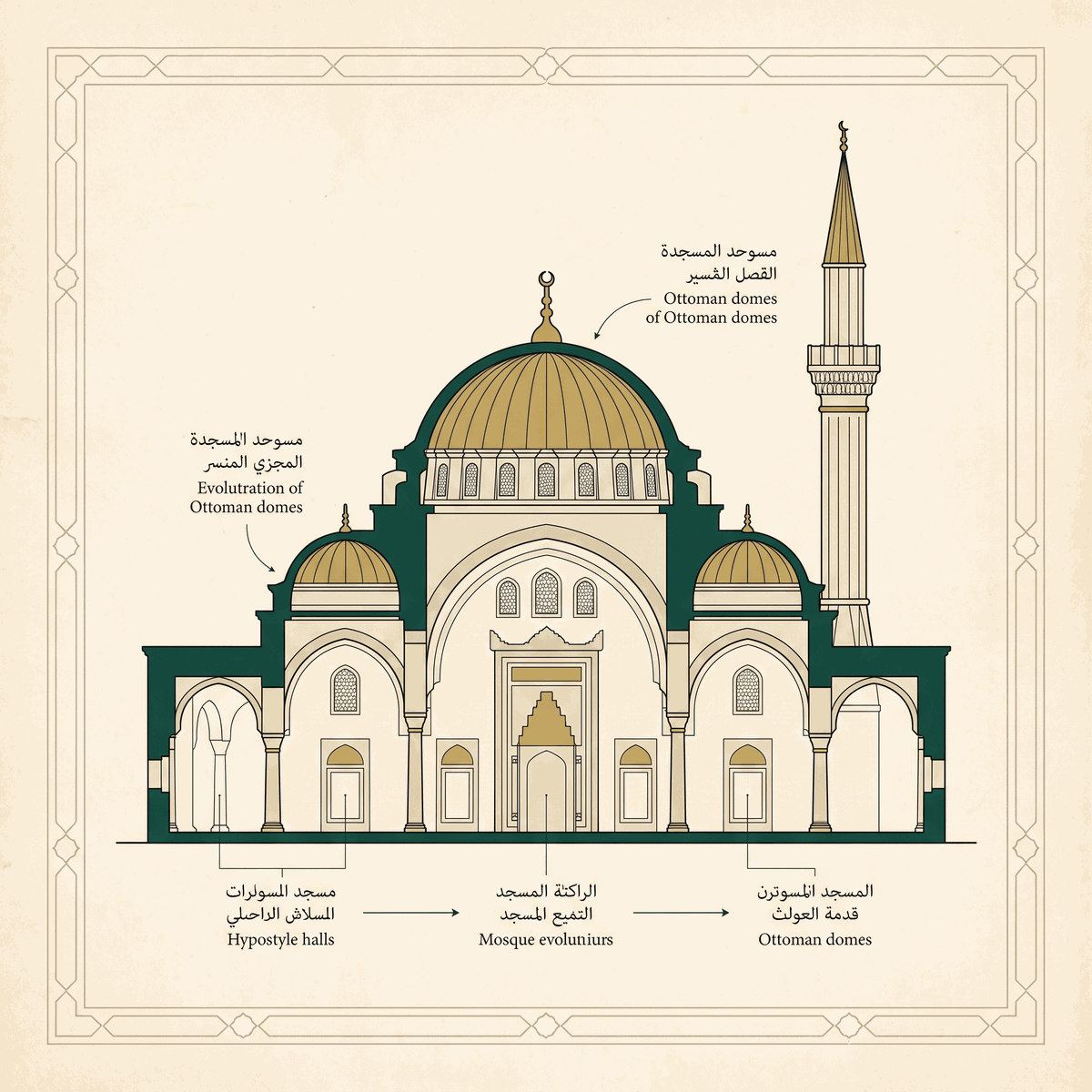
When walking into a serene prayer hall, whether under the soaring dome of an imperial landmark or inside a local Mauritian neighbourhood masjid, believers often reflect on how mosque architecture came to be. How did the simple mud-brick courtyard of seventh-century Madinah evolve into the magnificent tapestry of arches, domes, and geometric patterns seen across the Muslim world today? Understanding the history of mosque architecture unveils a rich story of faith, cultural synthesis, and artistic creativity that spans over fourteen centuries.
The Humble Origins: The Prophet’s Mosque in Madinah
The foundational prototype of all mosques was Al-Masjid an-Nabawi, established by the Prophet Muhammad (peace be upon him) upon his arrival in Madinah in 622 CE. Far from being a grand monument, this original sanctuary was wonderfully humble. It consisted of an open rectangular courtyard enclosed by sun-dried mud-brick walls, with roofed areas supported by palm-trunk columns and thatched with palm fronds.
Despite its physical simplicity, the Prophet’s Mosque established the core functional requirements for sacred Islamic space. It was oriented toward the Qiblah (initially Jerusalem, and later Mecca), provided shelter from the elements, and maintained an unpretentious openness that welcomed all members of the community. Beyond daily congregational prayers, it served as a civic center, a court of law, a shelter for the destitute (Ahl al-Suffah), and a place for social gathering. Prophet Muhammad (peace be upon him) emphasized that sacredness resides in the devotion of the worshipper rather than physical splendor, stating: "The earth has been made for me a place of prayer and a means of purification" (Sahih al-Bukhari, Hadith 438).
The Classical Arab Hypostyle: Expansion and Functional Elements
As Islam spread rapidly across the Middle East, North Africa, and Andalusia during the Umayyad (661–750 CE) and Abbasid (750–1258 CE) caliphates, early Muslim builders adapted local Roman, Byzantine, and Persian masonry techniques to construct larger congregational mosques. The predominant early layout was the "hypostyle" mosque—a large hall where the flat roof is supported by a grid of uniform columns, opening into a spacious central courtyard (sahn).
During this golden era of expansion, the defining architectural features of the mosque solidified:
- The Mihrab: A semi-circular niche set into the Qiblah wall, indicating the direction of Mecca and amplifying the voice of the prayer leader.
- The Minbar: A stepped pulpit situated to the right of the Mihrab, used by the Imam to deliver the Friday sermon (khutbah).
- The Minaret: Soaring towers erected to broadcast the call to prayer (Adhan) across surrounding towns.
- The Sahn and Wudu Facilities: Central open-air courtyards equipped with fountains or basins for ritual purification (wudu).
Landmarks like the Great Mosque of Kairouan in Tunisia, the Great Mosque of Damascus in Syria, and the Grand Mosque of Córdoba in Spain showcase how the hypostyle structure created expansive, egalitarian prayer halls. Allah SWT mentions the nobility of caring for these sacred spaces: "The mosques of Allah are only to be maintained by those who believe in Allah and the Last Day and establish prayer and give zakah and do not fear except Allah" (Qur'an, At-Tawbah 9:18).
Regional Flourishing: Domes, Iwans, and Indo-Islamic Mastery
As Islamic civilization interacted with diverse cultures, distinctive regional architectural styles blossomed, demonstrating how faith harmonizes with local aesthetic genius:
- Persian Four-Iwan Style: In Iran and Central Asia, architects developed the four-iwan layout, characterized by vaulted rectangular halls (iwans) opening onto a central courtyard, crowned by magnificent turquoise tilework and tall entrance gateways (pishtaq), as seen in the Shah Mosque of Isfahan.
- Ottoman Imperial Style: Influenced by Byzantine structural engineering, Ottoman master architects—most notably Mimar Sinan in the 16th century—perfected the central-dome mosque. Structures like the Selimiye Mosque in Edirne and the Blue Mosque in Istanbul feature colossal central domes supported by cascading semi-domes and slender, pencil-shaped minarets.
- Indo-Islamic and Mughal Style: Across South Asia, Mughal emperors combined Persian grace with indigenous Indian masonry. This style produced iconic structures characterized by bulbous marble domes, decorative sandstone inlay, arched arcades, and delicate lattice screens (jali), as exemplified by the Badshahi Mosque in Lahore and the Jama Masjid in Delhi.
From Global Traditions to Mauritius: Local Mosque Architecture
The rich heritage of Islamic architecture travelled along trade routes across the Indian Ocean, making a lasting imprint on the island of Mauritius. As Muslim merchants and labourers arrived in the 19th century, they brought along rich building traditions, adapting them to the tropical island environment.
The premier example of this fusion is the historic Jummah Mosque in Port Louis, established in the 1850s. Occupying a prominent place in the island's capital, the Jummah Mosque reflects a captivating blend of Indian, Moorish, and classical European architectural influences. Its whitewashed facade, intricate wooden carved doors, peaceful central courtyard shaded by an ancient Indian almond tree, and decorative calligraphic bands offer a serene sanctuary amidst urban bustle. Throughout Mauritius, local masjids incorporate signature features such as elegant minarets, central domes, open airy prayer halls suited for warm climates, and meticulously crafted geometric tiles, exemplifying how universal Islamic design principles adapt seamlessly to local island heritage.
The Modern Mosque: Sustainability and Spiritual Continuity
In the contemporary era, architects are revisiting mosque design through the lens of modern engineering and environmental stewardship. Today's innovative mosques combine classic geometric symmetry with modern materials like reinforced concrete, glass, and sustainably harvested timber.
Recent landmarks, such as the eco-friendly Cambridge Central Mosque in the United Kingdom, utilize natural timber pillars resembling structural trees, solar power, and skylighting to minimize environmental impact. This modern trend honours the Quranic duty of environmental guardianship while preserving the spiritual essence of Islamic worship: creating a quiet, light-filled space dedicated to the remembrance of Allah.
A Sacred Legacy Built on Devotion
From a modest palm-roofed enclosure in Madinah to the grand architectural masterpieces found across Asia, Europe, and Mauritius, the mosque has evolved remarkably while retaining its core purpose. Ultimately, while domes, minarets, and intricate calligraphy inspire aesthetic wonder, the true honor of any mosque lies in the sincerity and devotion of the worshippers who gather within its walls to bow before Allah.
Frequently Asked Questions
What was the first mosque ever built in Islamic history?
The first mosque built in Islamic history is Masjid Quba, situated just outside Madinah. It was founded by the Prophet Muhammad (peace be upon him) upon his arrival during the Hijrah, shortly before he built Al-Masjid an-Nabawi in the heart of the city.
Why do mosques traditionally feature domes and minarets?
Domes and minarets were originally introduced for practical acoustic and architectural reasons. Domes helped amplify the Imam's voice inside large halls and improved air circulation, while minarets allowed the Muezzin's voice to carry across towns during the call to prayer. Over time, both features became recognizable cultural symbols of Islamic sacred architecture.
How does mosque design reflect Islamic spiritual values?
Mosque design emphasizes divine unity (Tawhid) and equality among believers. The absence of figurative imagery prevents idolatry, replacing it with geometric patterns, arabesques, and Quranic calligraphy that inspire contemplation of Allah's infinite perfection. Furthermore, the open, undivided prayer hall ensures that all worshippers stand shoulder-to-shoulder regardless of social status.
Sources
- Metropolitan Museum of Art: Islamic Art and Architecture
- Smarthistory: Introduction to Mosque Architecture
- https://smarthistory.org/introduction-to-mosque-architecture/
- UNESCO World Heritage Centre: Historic Islamic Architecture
- https://whc.unesco.org/en/list/
- Jummah Mosque Port Louis Historical Archives