
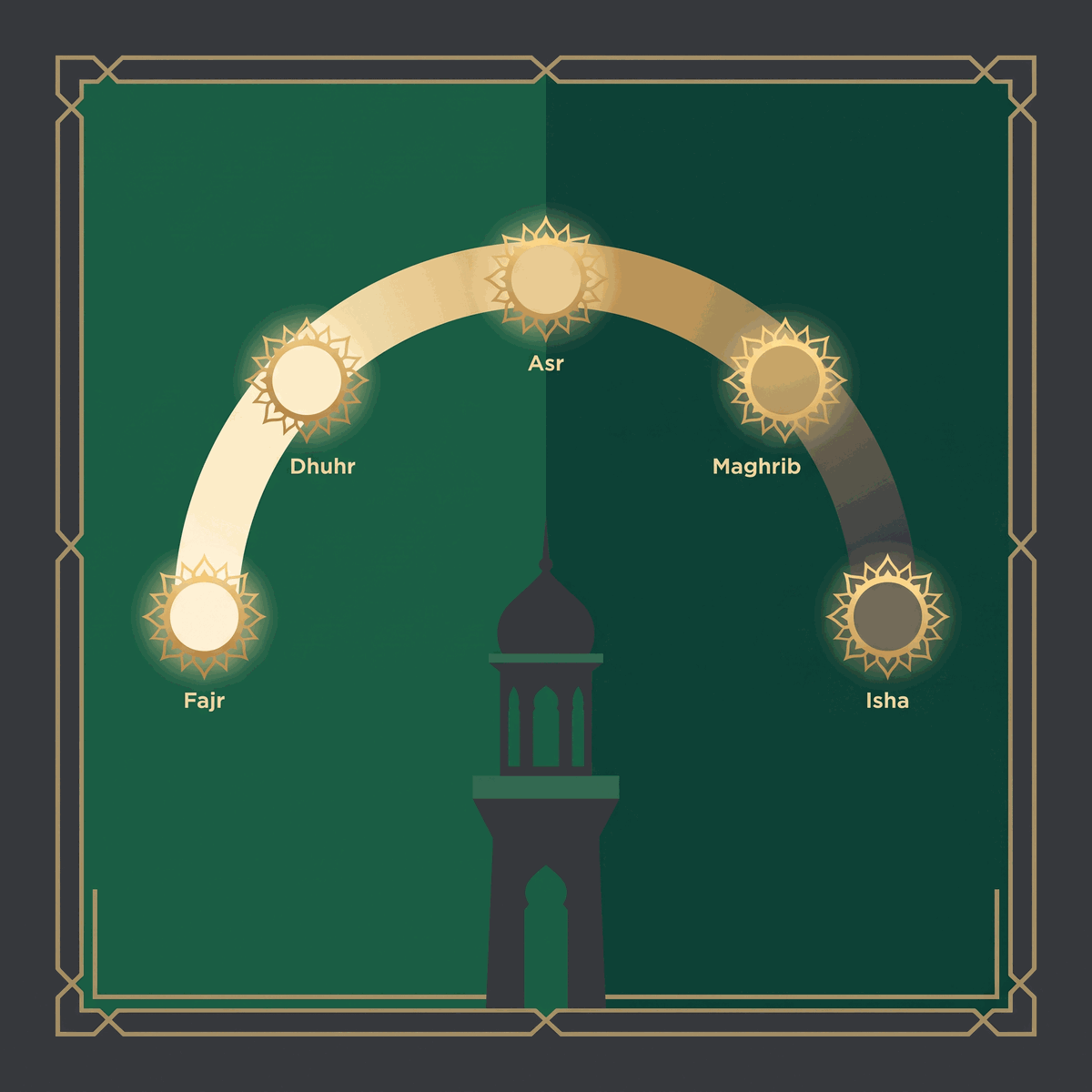
Establishing the five daily prayers (Salah) is the second pillar of Islam, serving as our daily spiritual anchor and direct line of communication with Allah (SWT). Many Muslims, whether establishing a consistent daily routine or seeking deeper clarity, often ask how the exact times for each prayer are determined and what time windows govern them. Understanding these natural timeframes helps ensure our worship is performed punctually, with mindfulness, and in accordance with Prophetic tradition.
The Divine Wisdom Behind Prescribed Prayer Windows
Prayer in Islam is not confined to a single moment of the day; rather, it is distributed across morning, afternoon, evening, and night. Allah explicitly highlights the importance of timely worship in the Holy Qur'an: "Indeed, performing prayer is a duty on the believers at prescribed times" (Qur'an, An-Nisa 4:103). This divine structure creates a spiritual rhythm, preventing worldly routine from distancing us from our Creator for too many consecutive hours.
The prayer schedule was brought directly to Prophet Muhammad (peace and blessings be upon him) through the Angel Jibreel (Gabriel). Angel Jibreel led the Prophet (peace be upon him) in prayer over two consecutive days—once at the earliest start of each time window and once at its closing boundary—to demonstrate the exact limits for each Salah (Sahih Muslim, Hadith 612).
By tying prayer times to the movement of the sun, Islam links our daily devotion to the natural cosmos. Whether observing true dawn, the sun's meridian, or twilight, every prayer serves as a gentle reminder of Allah's magnificent universe and our place within it.
Detailed Breakdown of the 5 Daily Prayer Windows
Each of the five obligatory prayers has a defined time window with a specific start and end point. Below is a detailed look at how each window is defined according to classical Islamic jurisprudence.
1. Fajr (The Dawn Prayer)
- Start Time: True dawn (Subh Sadiq). This occurs when a horizontal white light appears across the eastern horizon.
- End Time: Sunrise (Tulu' ash-Shams), when the top edge of the sun's disc appears above the horizon.
- Guidance: It is highly recommended to perform Fajr early in its window, leaving sufficient time before sunrise.
2. Dhuhr (The Midday Prayer)
- Start Time: Zawal, which is immediately after the sun passes its zenith (highest point in the sky) and begins to decline toward the west.
- End Time: According to the dominant view in the Hanafi school (traditionally observed across Mauritius and South Asia), Dhuhr ends when the shadow of an object becomes twice its length, plus its original shadow at noon (Mithlayn). In the Shafi'i, Maliki, and Hanbali schools—as well as the position of Imam Abu Yusuf and Imam Muhammad al-Shaybani within the Hanafi school—Dhuhr ends when an object's shadow equals its single length (Mithl al-Awwal).
3. Asr (The Late Afternoon Prayer)
- Start Time: Asr begins immediately when the Dhuhr window closes. In standard Hanafi practice, this is when an object's shadow reaches twice its height. In the other Sunni schools, it begins when the shadow equals the object's height.
- End Time: Sunset (Ghurub ash-Shams). However, delaying Asr until the sun turns pale or yellow in the sky is considered makruh (disliked), except in cases of absolute necessity.
4. Maghrib (The Sunset Prayer)
- Start Time: Immediately after the sun's disc completely disappears below the western horizon.
- End Time: The disappearance of twilight (Shafaq). In classical Hanafi jurisprudence, Maghrib extends until the white twilight (Shafaq al-Abyad) disappears from the sky. In the Shafi'i, Maliki, and Hanbali schools, it ends when the red twilight (Shafaq al-Ahmar) fades. Because Maghrib has a relatively short window, it is sunnah to perform it promptly after the Athan.
5. Isha (The Night Prayer)
- Start Time: Begins when the Maghrib window ends with the complete disappearance of evening twilight.
- End Time: True dawn (Subh Sadiq). While the valid timeframe for Isha lasts until dawn, it is strongly encouraged to complete Isha before Islamic midnight (the exact midpoint between sunset and true dawn).
Prohibited and Disliked Times for Prayer
While voluntary (Nafl) prayers bring immense spiritual reward, Islamic jurisprudence specifies three times during the day when offering voluntary prayers is strictly prohibited or disliked (Karahah).
- During Sunrise: From the moment the sun begins to rise until it ascends about a spear's height above the horizon (approximately 15 to 20 minutes after sunrise, known as Ishraq time).
- At Zenith (Zawal): When the sun is at its absolute highest point in the sky at mid-day, lasting just a few minutes until it moves past the meridian.
- During Sunset: When the sun becomes pale and begins setting, until it completely disappears. An exception is made if someone has not yet prayed the obligatory Asr of that day due to a genuine excuse; they must pray it before sunset rather than missing it entirely.
The Companion Ukbah ibn Amir (may Allah be pleased with him) narrated: "There are three times at which the Messenger of Allah (peace be upon him) forbade us to pray or to bury our dead: when the sun rises until it fully ascends, when the sun is directly overhead at noon until it passes its meridian, and when the sun inclines toward setting until it disappears" (Sahih Muslim, Hadith 831).
Astronomical Calculations and Using the Site Prayer Tool
In ancient times, Muslims determined prayer times by observing physical shadows and the sky directly. Today, modern astronomy allows us to calculate the sun's position relative to Earth with high mathematical precision.
Prayer calculation methods take into account key parameters such as solar declination, geographic latitude, and twilight angles below the horizon (typically 18° or 15° for Fajr and Isha calculations). In Mauritius, tropical daylight shifts throughout the year alter prayer times gradually between summer and winter months.
Rather than trying to estimate shadow lengths manually, you can easily access real-time schedules calibrated for local Mauritian towns using the islam.mu Prayer Times tool. This ensures that whether you live in Port Louis, Curepipe, Rose Hill, or Flacq, your daily worship stays accurate to the minute.
Frequently Asked Questions About Prayer Times
What should I do if I accidentally miss a prayer window?
If you miss a prayer due to sleep or genuine forgetfulness, you must perform it as soon as you remember. This is known as Qada (makeup prayer). Prophet Muhammad (peace be upon him) said: "Whoever forgets a prayer or sleeps through it, its expiation is to offer it as soon as he remembers it" (Sahih Muslim, Hadith 684). You should make sincere intention to pray the missed obligatory prayer immediately.
Can a Hanafi pray Asr in congregation behind a Shafi'i Imam at an earlier shadow time?
Yes, major Hanafi jurists state that praying in congregation (Jama'ah) holds high priority. When praying at a mosque following the Shafi'i schedule (where Asr starts at single shadow length), a Hanafi believer may adopt the position of Imam Abu Yusuf and Imam Muhammad al-Shaybani (the two main disciples of Imam Abu Hanifa) or the majority view, thereby joining the congregation without hesitation.
How is Islamic midnight calculated for Isha prayer?
Islamic midnight is not 12:00 AM on the clock. It is calculated by determining the exact total time between sunset (Maghrib start) and true dawn (Fajr start), then dividing that total duration by two and adding it to sunset time. Completing Isha before this midpoint is highly recommended in Sunni jurisprudence.
Summary Takeaway
Maintaining the five daily prayers within their prescribed windows brings immense spiritual stability, discipline, and divine blessing into a Muslim's life. By aligning our daily schedule with the sun's movement and making use of accurate local tools like the islam.mu Prayer Times tool, we fulfill Allah's command with clarity and peace of mind.
Sources
- Qur'an, An-Nisa 4:103
- Sahih Muslim, Hadith 612
- Sahih Muslim, Hadith 831
- Sahih Muslim, Hadith 684
- https://islam.mu/prayer-times