
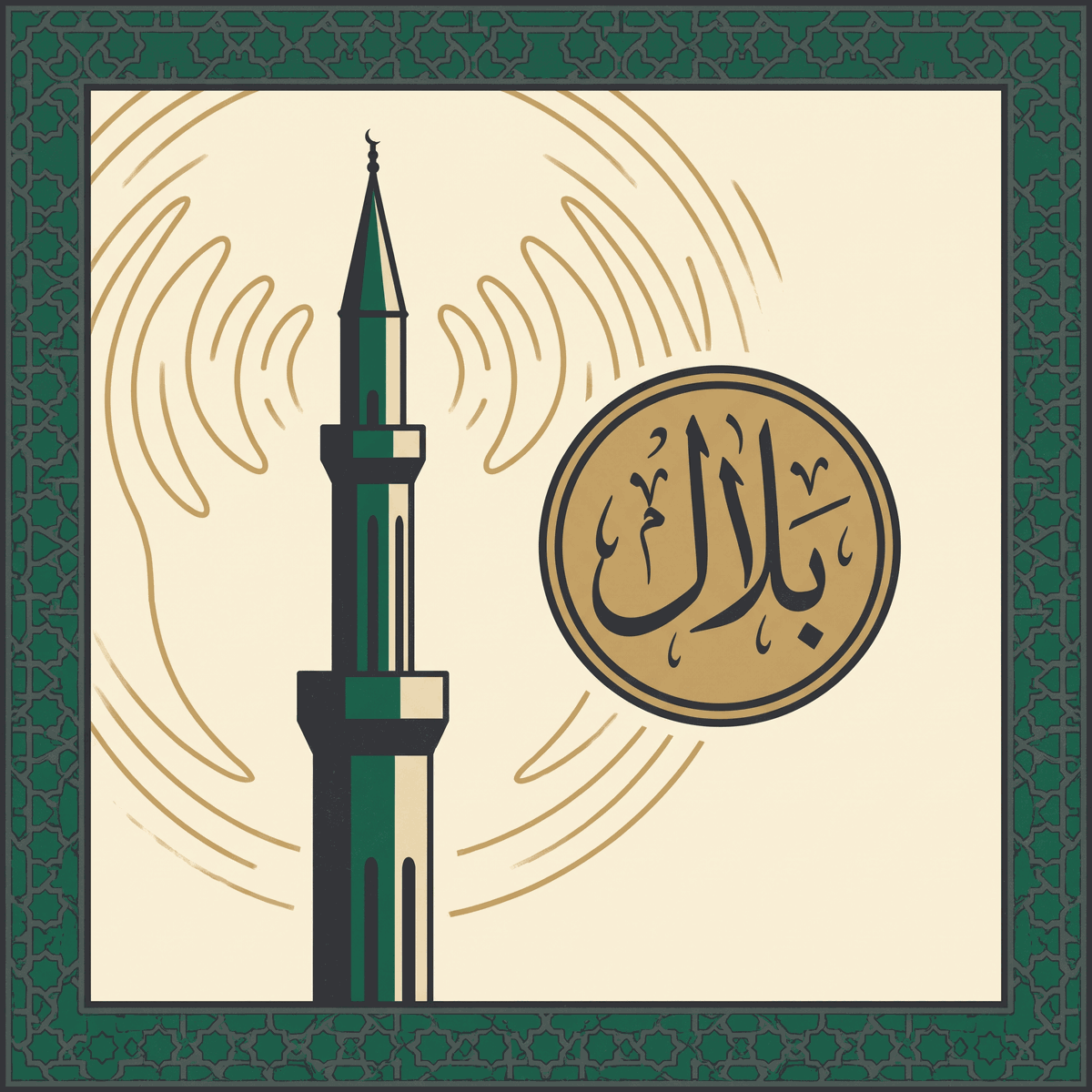
How did a man who began his life in servitude become one of the most honored leaders in early Islamic history? The life of Bilal ibn Rabah (RA) offers a timeless blueprint of faith, spiritual fortitude, and human dignity. As the first muezzin of Islam, his clear voice called the believers to prayer, symbolizing the revolutionary Quranic truth that nobility is determined by piety rather than lineage or skin color.
Early Life and Conversion to Islam
Bilal ibn Rabah (RA) was born in Makkah in the late sixth century. His father, Rabah, and mother, Hamamah, were of Abyssinian origin. As an enslaved youth, Bilal (RA) belonged to Umayyah ibn Khalaf, an influential chieftain of the pagan Quraish tribe. Despite his humble social status, Bilal (RA) possessed a discerning mind and an upright character, earning a reputation for honesty and reliability among those who knew him.
When Prophet Muhammad ﷺ began inviting the people of Makkah to the worship of the One God, the message spread quietly among the city's residents. Bilal (RA) recognized the truth of Tawhid (monotheism) immediately upon hearing it. He was among the earliest individuals to accept Islam, publicly declaring his faith during a period when open belief carried severe personal risk, particularly for those without tribal protection.
Unshakeable Endurance and Emancipation
Upon discovering that Bilal (RA) had embraced Islam, Umayyah ibn Khalaf subjected him to relentless physical torture in an effort to force a renunciation of his faith. During the peak of the Arabian summer heat, Umayyah had Bilal (RA) dragged out into the blistering desert sand. Heavy boulders were placed on his chest to compress his breathing while his tormentors demanded that he praise the pagan idols Lat and 'Uzza.
Despite the excruciating pain, Bilal (RA) refused to yield. In response to every demand, he uttered a simple, iconic declaration of faith: "Ahad, Ahad" ("He is One, He is One"). His unwavering resolve under extreme hardship became a symbol of spiritual endurance for early Muslims.
Observing his unbearable suffering, Abu Bakr al-Siddiq (RA) intervened. He negotiated with Umayyah ibn Khalaf and purchased Bilal's freedom for a substantial sum of gold, emancipating him for the sake of Allah alone. Years later, the second Caliph, Umar ibn al-Khattab (RA), would reflect on this historic act by saying: "Abu Bakr is our master, and he emancipated our master" (Sahih al-Bukhari, Hadith 3754).
Becoming the First Muezzin of Islam
Following the migration (Hijrah) of Muslims to Madinah, the newly formed Islamic community required a systematic way to gather believers for the five daily prayers. After several companions, including Abdullah ibn Zayd (RA) and Umar ibn al-Khattab (RA), shared visions of the call to prayer (Adhan), Prophet Muhammad ﷺ instructed Bilal (RA) to learn the words and make the announcement.
Prophet Muhammad ﷺ selected Bilal (RA) because of his resonant, melodious voice and deep spiritual devotion. He became the official Mu'adhdhin (caller to prayer) at the Prophet's Mosque in Madinah, fulfilling this noble duty throughout the Prophet's remaining life.
A defining moment in Islamic history occurred during the Conquest of Makkah in the eighth year after Hijrah (630 CE). Upon entering the sanctuary, Prophet Muhammad ﷺ ordered the cleansing of the Ka'bah of all idols. He then instructed Bilal (RA) to climb atop the sacred house and proclaim the Adhan across Makkah. Standing on top of the Ka'bah, the former slave who had once been tortured in Makkah's desert sands now called the city to the worship of One Allah. This historic event demonstrated Islam's total rejection of racial arrogance and social hierarchy, fulfilling the Quranic principle: "O mankind, indeed We have created you from male and female and made you peoples and nations that you may know one another. Indeed, the most noble of you in the sight of Allah is the most righteous of you" (Qur'an, Al-Hujurat 49:13).
Virtues and Closeness to Prophet Muhammad ﷺ
Throughout his life in Madinah, Bilal (RA) enjoyed a uniquely close bond with Prophet Muhammad ﷺ. He served not only as the muezzin but also as a trusted personal assistant and treasurer to the Prophet ﷺ during military expeditions and community gatherings. He participated in every major battle, including Badr and Uhud, fighting alongside the Messenger of Allah.
His spiritual stature was affirmed by divine tidings during his lifetime. In a renowned tradition narrated by Abu Hurairah (RA), Prophet Muhammad ﷺ asked Bilal (RA) at the time of the Fajr prayer: "O Bilal, tell me of the most promising deed you have done in Islam, for I heard the sound of your shoes in front of me in Paradise." Bilal (RA) replied: "I have not done any deed more hopeful to me than that whenever I perform ablution (wudu) during the day or night, I perform prayer after that ablution as much as is written for me" (Sahih al-Bukhari, Hadith 1149). This practice, known as Tahiyyat al-Wudu, remains a cherished Sunnah practiced by Muslims worldwide today.
Legacy and Final Years in Sham
The passing of Prophet Muhammad ﷺ brought deep sorrow to Madinah. When Bilal (RA) attempted to recite the Adhan after the Prophet's death, he found himself overwhelmed by grief upon reaching the words "Ash-hadu anna Muhammadan Rasulullah" ("I bear witness that Muhammad is the Messenger of Allah") and could not finish the call. Unable to bear remaining in Madinah without the Prophet's physical presence, Bilal (RA) requested permission from Caliph Abu Bakr (RA) to join the Islamic armies defending the borders in Sham (Greater Syria).
Bilal (RA) spent his final years in Syria, participating in military campaigns and living a peaceful life dedicated to worship and service. On rare occasions, he was persuaded to perform the Adhan—most notably when Caliph Umar ibn al-Khattab (RA) visited Syria, bringing those who heard him to tears as they recalled the blessed days of the Prophet ﷺ.
Bilal ibn Rabah (RA) passed away in Damascus around 20 AH (640 CE) during his sixties. His burial place in Damascus remains a quiet monument to a life of extraordinary devotion. For the Muslim ummah, the legacy of Bilal (RA) endures as a beacon of equality, patience, unwavering faith, and devotion to the sacred call of prayer.
Sources
- Sahih al-Bukhari, Hadith 1149
- Sahih al-Bukhari, Hadith 3754
- Al-Tabaqat al-Kubra by Ibn Sa'd
- https://en.wikipedia.org/wiki/Bilal_ibn_Rabah
- https://themuslimvibe.com/faith-islam/bilal-ibn-rabah-the-first-muezzin-of-islam