
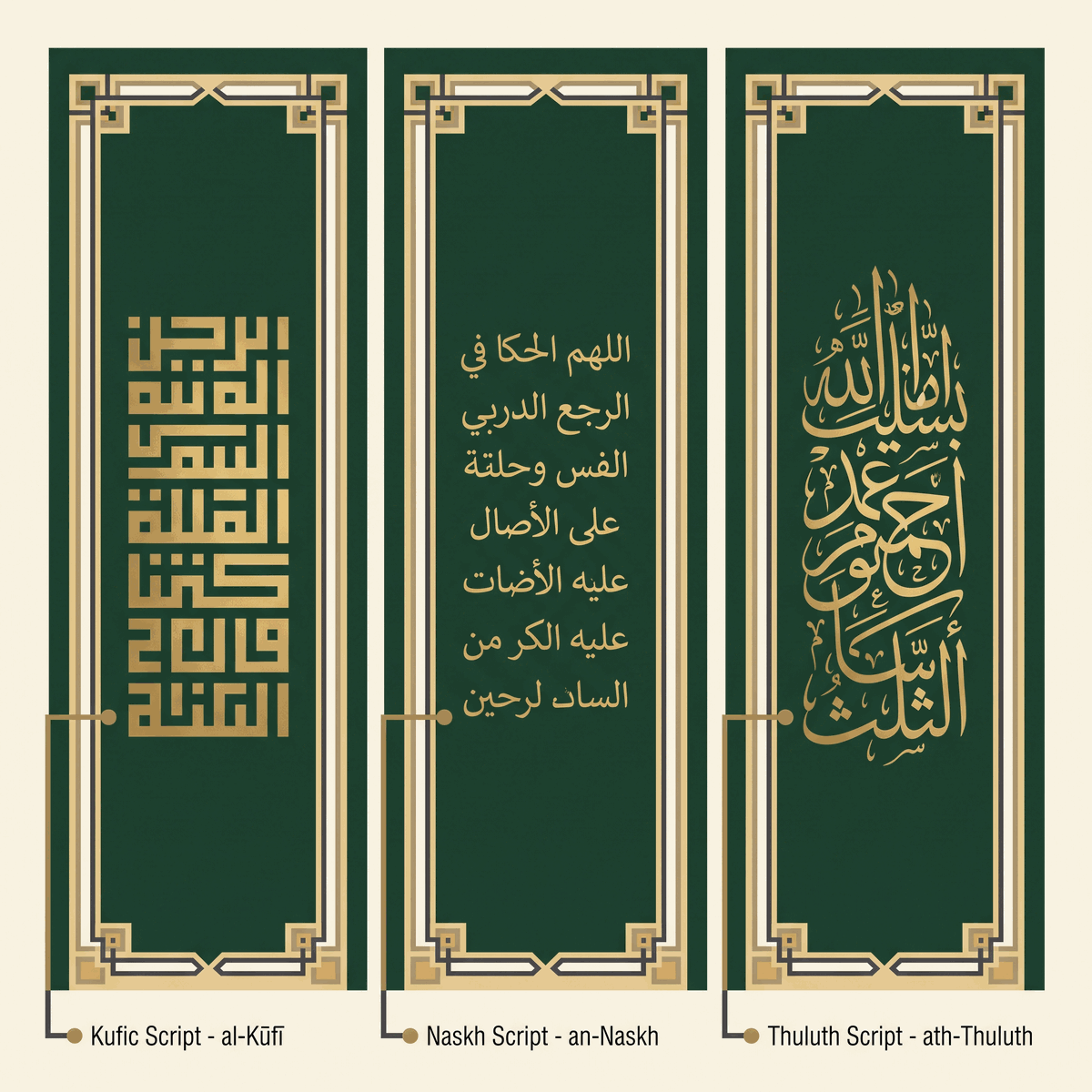
When admiring the intricate script on the walls of a historic mosque or scanning the pages of a handwritten Mushaf, many Muslims and art enthusiasts wonder how to distinguish the various styles of Arabic calligraphy. Arabic calligraphy (al-khatt al-arabi) is far more than decorative lettering; it is a sacred art form deeply entwined with the preservation of Islamic divine revelation. Understanding the subtle curves of Naskh, the monumental presence of Thuluth, and the historic geometry of Kufic reveals the rich heritage behind Islamic artistic expression.
The Sacred Foundations of Arabic Calligraphy
In Islamic tradition, the written word carries immense honor because Allah revealed the Holy Qur'an in Arabic. The sacred act of writing is mentioned directly in revelation, where Allah highlights the divine gift of the pen: "Who taught by the pen—taught man that which he knew not" (Qur'an, Al-Alaq 96:4-5). Allah also swears by the writing instrument in Surah Al-Qalam, stating: "Nun. By the pen and what they write" (Qur'an, Al-Qalam 68:1).
Because classical Islamic art largely avoids figurative imagery in worship spaces to preserve strict monotheism (tawhid), calligraphy became the supreme visual art of the Muslim world. Over centuries, master calligraphers developed precise geometric principles to govern script proportions. In the 10th century, the famous Abbasid calligrapher Ibn Muqla established the system of al-khatt al-mansub (proportioned script). He used a single rhombic dot (nuqta) created by the tip of a reed pen (qalam) as the universal unit of measurement, ensuring perfect balance across all letterforms.
Kufic Script: The Ancient, Geometric Masterpiece
Kufic is the oldest codified style of Arabic calligraphy, originating in the city of Kufa, Iraq, during the 7th century. Characterized by straight horizontal lines, sharp right angles, and bold geometric structures, early Kufic was the dominant script used to record the earliest complete manuscripts of the Holy Qur'an on parchment.
Because early Kufic prioritized majestic permanence over rapid writing, it features static, imposing letterforms. Over time, as paper replaced parchment and architectural decoration expanded, calligraphers developed elaborate variations such as Foliated Kufic (incorporating leaf designs), Floriated Kufic (interwoven with floral scrolls), and Square Kufic (Kufi Murabba'). Square Kufic is constructed entirely on a grid, making it a favorite for tilework on minarets, domes, and brick facades across Central Asia, North Africa, and the Middle East.
Naskh Script: The Standard of Clarity and Sacred Texts
While Kufic dominated early Islamic history, its rigid angles made it time-consuming to write for everyday correspondence and lengthy texts. By the 10th century, the Naskh script emerged as the premier cursive style. The word Naskh derives from the Arabic root meaning "to transcribe" or "to copy," reflecting its primary role in bookmaking and official administrative record-keeping.
Refined by master calligraphers like Ibn Muqla and Ibn al-Bawwab, Naskh is recognized by its smooth, rhythmic curves, upright vertical lines, and exceptional legibility. The letters are proportioned to avoid overcrowding, allowing readers to parse complex texts quickly and accurately. Today, Naskh remains the universal standard for printed Qur'anic manuscripts, school textbooks, newspapers, and digital Arabic typography across the Muslim world.
Thuluth Script: The Majestic King of Monumental Inscriptions
If Naskh is the script of clarity, Thuluth is the grand script of majesty and imperial elegance. The name Thuluth translates to "one-third," referring to the calligraphic rule where one-third of each stroke slants or curves relative to the pen width. Developing alongside Naskh during the Golden Age of Islam, Thuluth was perfected under Abbasid, Mamluk, and Ottoman calligraphers.
Thuluth is characterized by tall, commanding vertical stems, deep sweeping curves, and complex compositions where words interweave gracefully across multiple levels. Because of its grand scale and expressive flair, Thuluth is rarely used for full text bodies. Instead, it serves as the ultimate script for architectural inscriptions, mosque entry archways, surah headings in the Qur'an, ceramic wall bands, and decorative banners like the Kiswah covering the Holy Ka'bah in Makkah.
Key Differences: Kufic, Naskh, and Thuluth Compared
Understanding how these three iconic scripts compare helps readers appreciate their distinct roles in Islamic art, history, and daily religious practice:
| Calligraphy Style | Visual Characteristics | Historical Origin | Primary Practical Use |
|---|---|---|---|
| Kufic | Rigid, angular, geometric, straight lines, square layouts | 7th century (Kufa, Iraq) | Architectural tilework, brickwork, early Qur'anic parchments |
| Naskh | Fluid, rounded, balanced, moderate spacing, high legibility | 10th century (Baghdad) | Printed Qur'an copies (Mushaf), books, body text, digital fonts |
| Thuluth | Tall verticals, deep curves, layered interweaving text | 9th–10th century (Middle East) | Mosque inscriptions, surah titles, architectural bands, Kiswah |
While Kufic provides a feeling of timeless, structural stability, Naskh offers effortless readability, and Thuluth delivers theatrical, divine grandeur. Together, they represent the incredible breadth of traditional Arabic penmanship.
Preserving a Sacred Visual Heritage
Arabic calligraphy remains a living artistic tradition that connects contemporary Muslims to centuries of spiritual devotion, scholarship, and architectural beauty. Whether carved into stone in historical monuments or printed in modern copies of the Qur'an, these master scripts reflect a profound commitment to elevating the divine word. Exploring these traditional styles allows believers and art lovers alike to see the deep harmony between faith, geometry, and artistic excellence.
Frequently Asked Questions
What is the main difference between Naskh and Thuluth?
Although both are cursive scripts developed during the same historical era, Naskh is designed for maximum clarity and fast reading in long books, whereas Thuluth features elongated vertical lines and complex interweaving layers designed primarily for grand decorative and architectural displays.
Why is Kufic script often seen on mosque walls and brickwork?
Kufic script is inherently geometric and built around straight horizontal and vertical lines. This structural design makes it ideal for architectural mediums like carved stone, ceramic tile mosaics, and decorative brickwork where curved scripts are difficult to execute.
Which style of calligraphy is used in the modern printed Qur'an?
The standard printed Qur'an (Mushaf) used around the world today, including the famous Medina edition, is written predominantly in the Naskh script because of its unmatched legibility and balanced letter proportions.
Sources
- Metropolitan Museum of Art - Calligraphy in Islamic Art
- UNESCO Intangible Cultural Heritage - Arabic Calligraphy
- Encyclopedia Britannica - Arabic Calligraphy History
- Victoria and Albert Museum - Islamic Calligraphy Scripts